5 Best Property Inspection Software Platforms for Property Developers
Alyssa Castillo
Property inspections influence what a developer pays, accepts, rectifies and eventually hands over.
The right software should therefore preserve inspection findings as usable project information, with photographs, locations, responsibilities and resolution dates attached. Morta.com takes this further by connecting inspections and defects with the wider development record, giving property developers one place to manage activity from the early appraisal through to delivery and post-handover.
For developers, this distinction matters. An inspection may begin as a site visit, but its findings can affect contractor performance, payment decisions, completion dates, purchaser satisfaction and the final development margin. A photograph stored in a camera roll has limited commercial value if nobody can connect it to the relevant unit, contractor, drawing or outstanding action.
The best property inspection software should make it practical to document issues on site and follow them through to closure. It should also help senior teams understand whether inspection findings are isolated defects or evidence of a wider quality problem across a project or portfolio.
This review examines five established platforms from the perspective of an independent or corporate property developer. Each product has genuine strengths, although the right choice depends on whether the business needs a dedicated inspection application, a construction management platform or property development software covering the entire development lifecycle.
Property inspections take place throughout development. A developer may inspect a building before acquisition, review work during construction, complete quality inspections before practical completion and manage snagging or defects after handover.
The purpose changes at each stage, but the need for reliable evidence remains consistent. Inspection records should establish what was reviewed, where the issue was found, when it was identified and what happened next. Weak records can make it difficult to assess responsibility or demonstrate whether corrective work has been completed properly.
Current building control guidance places increasing emphasis on the quality and accessibility of inspection information. The UK Government’s 2026 Building Control Independent Panel report recommended consistent inspection data, automated capture and stronger real-time oversight. Although the report concerns the regulatory system, the underlying principle is useful for developers managing their own quality and compliance processes.
Property inspection reports also contribute to commercial control. Recurring defects can delay handover, consume retention, generate additional professional fees and create customer service costs after occupation. An inspection platform should help the developer identify these patterns while there is still time to intervene.
How This Property Inspection Software Was Assessed
This comparison focuses on the practical needs of property developers rather than professional home inspectors working on isolated residential surveys. A developer normally needs inspection information to circulate through a project team and remain available after the initial site visit.
The assessment considers how each platform captures evidence, assigns corrective actions, follows defects to resolution and produces inspection reports. It also considers how well the software supports several projects, contractors, buildings or units.
Particular weight has been given to the relationship between inspections and the wider development. A specialist inspection app may perform extremely well on site, while a broader system may offer greater value when inspection findings need to influence handover, cost reporting or portfolio decisions.
Software
Best suited to
Principal strength
Morta
Property developers managing the full development lifecycle
Inspections, defects and handover connected to wider project information
PlanRadar
Site teams requiring visual defect and snagging workflows
Plan-based tickets and structured defect tracking
SafetyCulture
Businesses standardising inspections across many locations
Flexible checklists, scheduling and inspection analytics
Procore
Large construction teams using a broad delivery platform
Extensive quality and safety management
GoAudits
Teams prioritising mobile and offline inspections
Accessible inspection capture and automated reporting
1. Morta: Best Overall Property Inspection Software for Property Developers
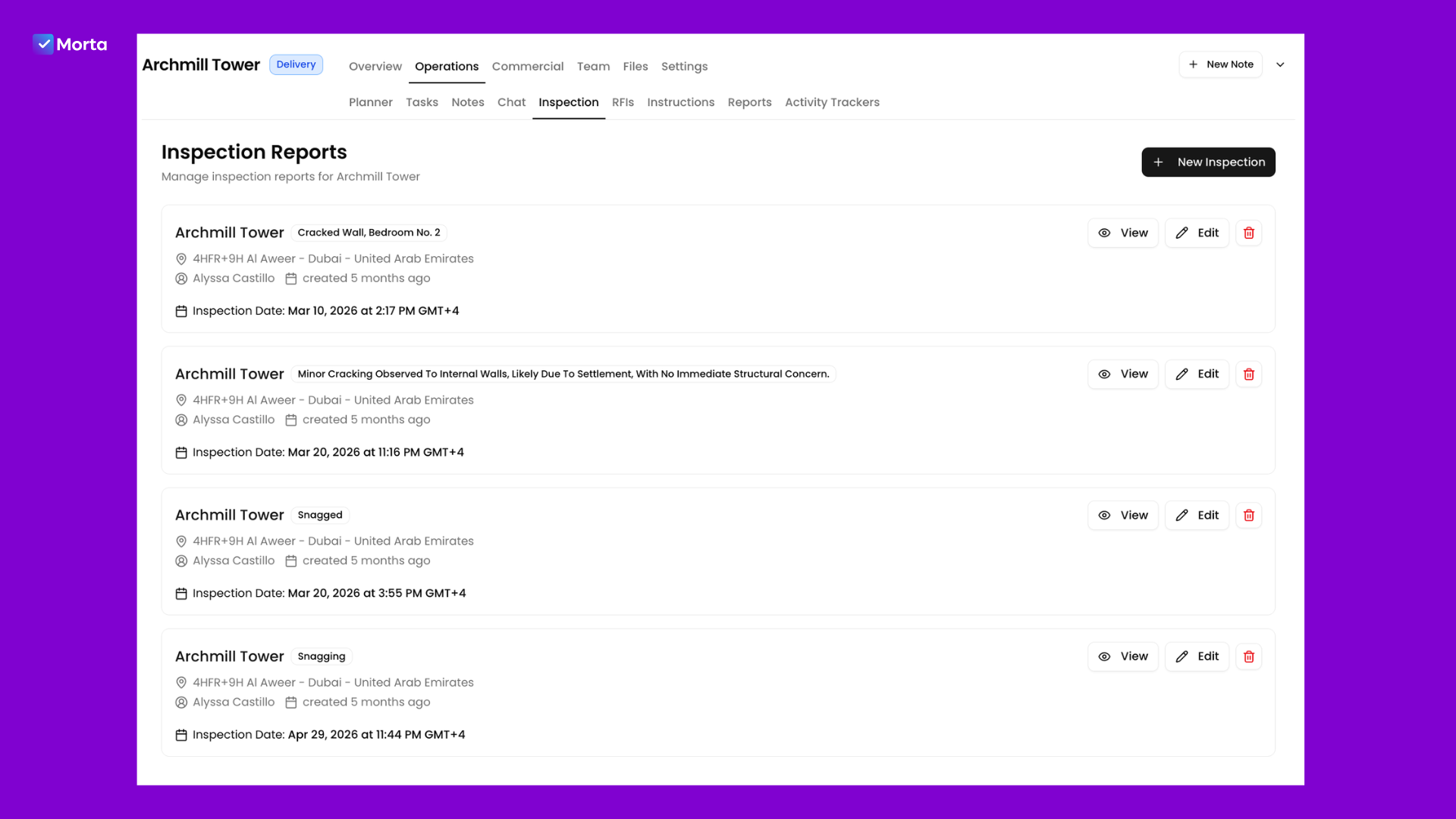
Morta is the strongest overall option in this comparison for property developers because its inspection and defect management capabilities sit inside a platform designed specifically around development. Inspection findings remain connected to the project that created them, including the people, files, actions and handover processes surrounding the issue.
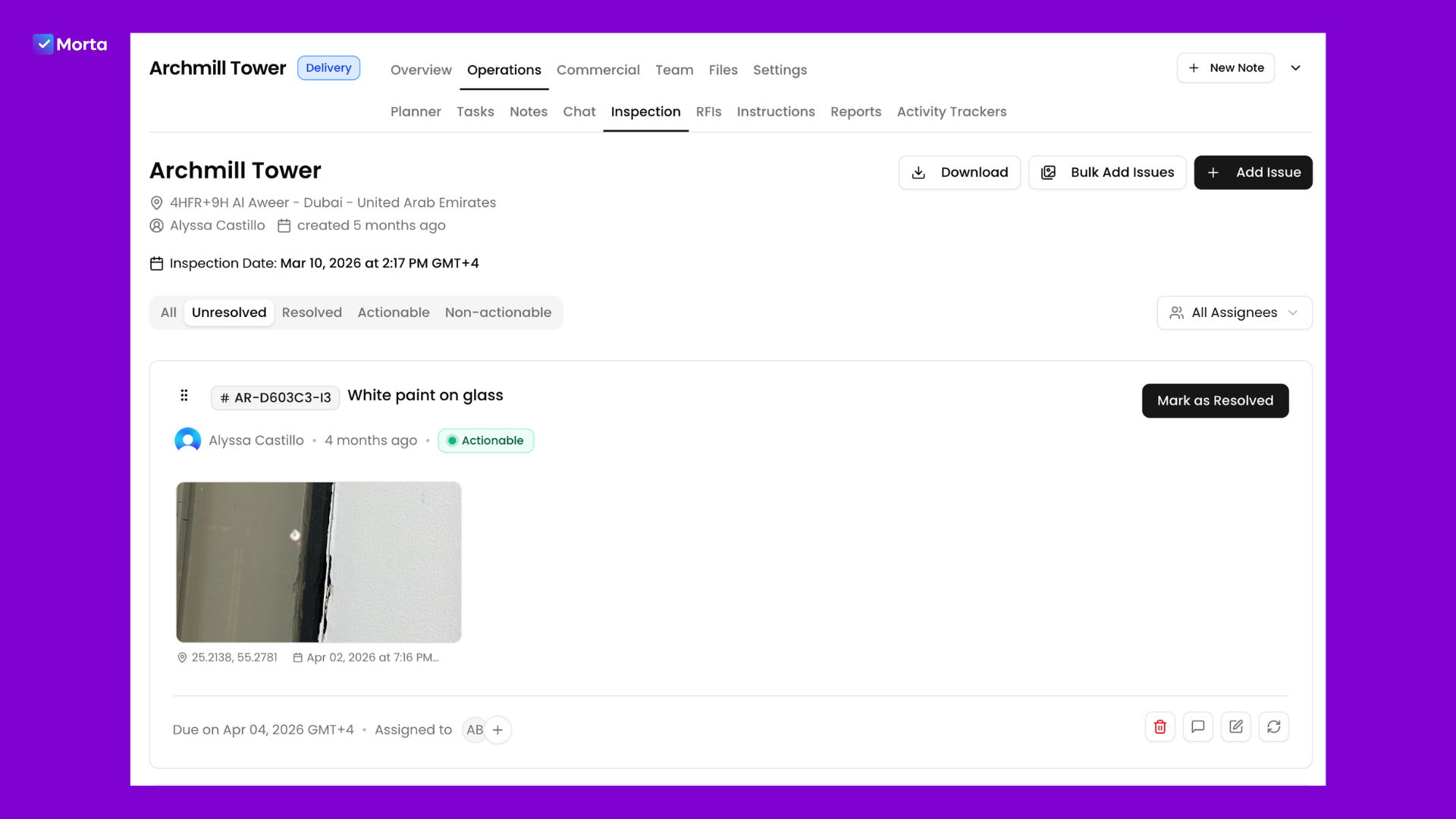
During an inspection, teams can capture defects, record evidence and assign responsibility for corrective work. The issue can then be monitored until it has been addressed and verified. Morta’s post-handover and snagging software is designed to help teams capture issues quickly, allocate work and maintain a clear resolution process.
The value for a developer becomes clearer when inspections form part of a live development rather than a separate field exercise. A defect discovered during a quality inspection may relate to a contractor, package, unit or project phase. Keeping that context within the same software reduces the amount of manual coordination required to understand the issue later.
Morta also supports activity beyond property inspections. Its wider tools cover areas such as development appraisals, planning, CRM, budgeting, procurement, collaboration, reporting, handover and defect management. This gives developers a continuous record from pre-construction to completion, with inspection information contributing to the same source of project data.
Where Morta Performs Best
Morta is particularly suitable for developers managing several schemes, phases or units. Portfolio teams can apply a more consistent approach to inspection records while retaining project-level detail. Senior management can review progress without waiting for separate reports to be compiled from different site systems.
It is also well suited to developers seeking software that can remain useful after the inspection has ended. An outstanding defect can be followed through the handover period, while the supporting evidence remains available to the delivery and post-completion teams.
Independent developers may find this continuity equally useful. Smaller teams often have one person covering several commercial and operational responsibilities. Maintaining appraisals, budgets, files and inspections in connected software can reduce the need to reconcile several applications personally.
Morta will be less relevant to a business seeking only a lightweight inspection checklist for occasional use. Its principal advantage appears when the developer wants property inspections to support broader project delivery and commercial oversight.
Why Morta Ranks First
A property developer does not receive value simply because an inspection report has been produced. The value arrives when the report leads to corrective action, protects quality and preserves an evidence trail through completion and handover.
Morta’s developer-focused structure supports that entire process. It enables inspections to remain part of the development record, which is why it ranks above platforms built mainly for generic audits, contractor administration or individual property surveys.
2. PlanRadar: Best for Visual Snagging and Plan-Based Issue Tracking
PlanRadar is a strong choice for developers and project teams that want to record issues directly against digital plans. Its interface is designed around tickets that can contain descriptions, photographs, deadlines, statuses and assigned responsibilities.
The company’s official snagging software allows teams to create and manage snag lists through web and mobile applications. Issues can be located on drawings, giving contractors and consultants a clear visual reference for where corrective work is required.
This plan-based workflow can be valuable on multi-unit residential developments, hotels and other projects where similar rooms or spaces make written descriptions difficult to interpret. A precise location reduces the risk of a contractor attending the wrong unit or closing an issue without addressing the correct area.
PlanRadar also offers customisable ticket and reporting templates. Developers can adapt the structure to different inspection types, project stages or client requirements. This makes the platform useful for snagging, fire safety checks, quality reviews and routine site inspections.
Where PlanRadar Performs Best
PlanRadar performs particularly well when site coordination is the main priority. Project managers and inspectors can create an issue during a walkthrough, attach visual evidence and assign it while still at the location.
Its reporting tools also help teams prepare structured property inspection reports from information captured in the field. This can reduce the time between completing a site visit and distributing the findings to contractors or clients.
The platform has a broad construction and real estate audience, which gives it flexibility across several use cases. Developers should still consider how inspection records will connect to their appraisal, procurement, cost and handover systems if those activities are managed elsewhere.
PlanRadar is a credible choice for visually detailed defect management. Morta has the advantage when the developer wants those defects to sit within a specialist end-to-end property development system.
3. SafetyCulture: Best for Custom Inspection Templates and Standardisation
SafetyCulture is widely used for digital inspections, audits and operational checks. Its strength lies in the ability to create repeatable checklists and deploy them across different sites, teams and inspection programmes.
The platform’s building inspection software supports digital checklists, scheduled inspections, photographs, videos, actions and centralised communication. Completed information can be analysed across sites, helping management identify recurring results or areas requiring attention.
For corporate developers with formal quality assurance procedures, this standardisation can be useful. A central team can prepare an approved property inspection template and distribute it across multiple projects. This supports a consistent inspection method even when different individuals perform the work.
SafetyCulture also provides a large template library. Teams beginning to digitise inspections can use existing templates as a starting point before adapting them to company standards, local regulations or specific asset types.
Where SafetyCulture Performs Best
SafetyCulture is particularly effective for businesses conducting repeated operational inspections. Health and safety reviews, quality checks, facilities inspections and compliance audits can all be managed through a similar workflow.
Its analytics can help users compare performance across sites and identify trends within completed inspections. This is valuable for developers that want to examine whether particular issues recur across projects, contractors or locations.
The platform serves many sectors, so its terminology and workflows are not exclusively designed around property development. Developers may need to configure the software carefully and maintain integrations or separate processes for appraisals, commercial reporting, procurement and handover.
SafetyCulture remains a strong option when inspection standardisation is the primary requirement. Its flexibility is a meaningful strength, particularly for organisations that expect the same platform to support property inspections alongside other operational audits.
4. Procore: Best for Large Construction Delivery Environments
Procore is an established construction management platform with extensive capabilities for quality, safety and field operations. It is a logical option for large delivery teams already using Procore across their construction projects.
Its construction site inspection software allows teams to digitise inspection forms, monitor issues and track quality or safety performance from desktop and mobile devices. Users can create observations, assign corrective actions and maintain a history of activity.
For developers working closely with major contractors, Procore can provide access to a mature construction delivery environment. Daily logs, drawings, inspections, observations and other site information can be managed within the same broader platform.
Its scale also supports complex projects with large consultant and contractor teams. Where Procore has already been adopted as the project’s main delivery system, using its inspection capabilities can avoid introducing another site application.
Where Procore Performs Best
Procore performs well on major construction projects requiring detailed control of field activity. Its quality and safety tools can support formal inspection programmes, issue management and contractor coordination.
The platform’s contractor and construction management heritage is one of its clearest strengths. Teams responsible for delivering works can manage a large volume of site information through established workflows.
Property developers should assess how closely those workflows match the information required at owner level. A developer may need visibility across acquisition, feasibility, financing, sales and portfolio performance, while Procore’s greatest depth sits within construction delivery.
This does not diminish its value for large site teams. It simply means that the software decision should reflect whether the developer needs a comprehensive construction platform or specialist software for property developers covering a broader commercial lifecycle.
5. GoAudits: Best for Straightforward Mobile and Offline Inspections
GoAudits offers an accessible inspection platform with particular strength in mobile data capture. It supports custom checklists, photographs, annotations, signatures and automated reports.
Its property inspection application includes offline functionality, allowing inspectors to complete checks in areas with limited connectivity. Data synchronises when an internet connection becomes available. This is useful on remote sites, inside basements or within buildings where mobile reception is unreliable.
GoAudits can also produce formatted reports from completed inspections. For teams moving away from paper forms or manually assembled documents, this can significantly shorten the reporting process.
The platform is designed for audits and inspections across multiple sectors. Its interface may therefore appeal to smaller teams that want to digitise property inspection reports without implementing a larger construction or development management system.
Where GoAudits Performs Best
GoAudits is well suited to structured inspections in which a standard form must be completed repeatedly. Property condition surveys, routine building checks and quality audits can be performed from a phone or tablet.
Offline access is a practical advantage. Inspection software loses much of its usefulness if site teams must postpone data entry until they return to an area with connectivity.
The trade-off is that GoAudits concentrates mainly on the inspection and reporting process. Developers requiring connected budgets, appraisals, procurement, project collaboration and post-handover management would need to operate those functions elsewhere.
For a straightforward mobile inspection workflow, GoAudits is a capable option. For a developer seeking a continuing project record, a broader platform will usually provide greater long-term value.
What Should Property Developers Look for in Inspection Software?
The first consideration is the type of property inspection the business performs. A developer inspecting potential acquisitions has different requirements from a delivery team managing thousands of snags across an apartment scheme.
The software should make evidence easy to capture on site. Photographs, annotations, dates and exact locations should remain attached to the relevant finding. Inspectors should be able to record information without creating additional administrative work once they return to the office.
Corrective action tracking is equally important. A completed inspection report only describes the condition observed at a particular time. Developers also need to know who is responsible for each issue, when the work is due and whether the resolution has been verified.
Property flipping projects can benefit from the same discipline. An independent developer purchasing, refurbishing and reselling a property needs a clear record of its initial condition, work completed and defects outstanding before sale. A well-maintained inspection history can support contractor discussions and reduce uncertainty during completion.
The final consideration is how inspection data will be used by the rest of the business. If the information affects project handover, contractor performance or management reporting, a standalone PDF may be insufficient. The selected platform should preserve the relationship between the finding and the development decision it influences.
Property Inspection Reports Should Support Action
Traditional property inspection reports are often treated as finished documents. They are circulated after a visit, reviewed in a meeting and eventually stored with the project files.
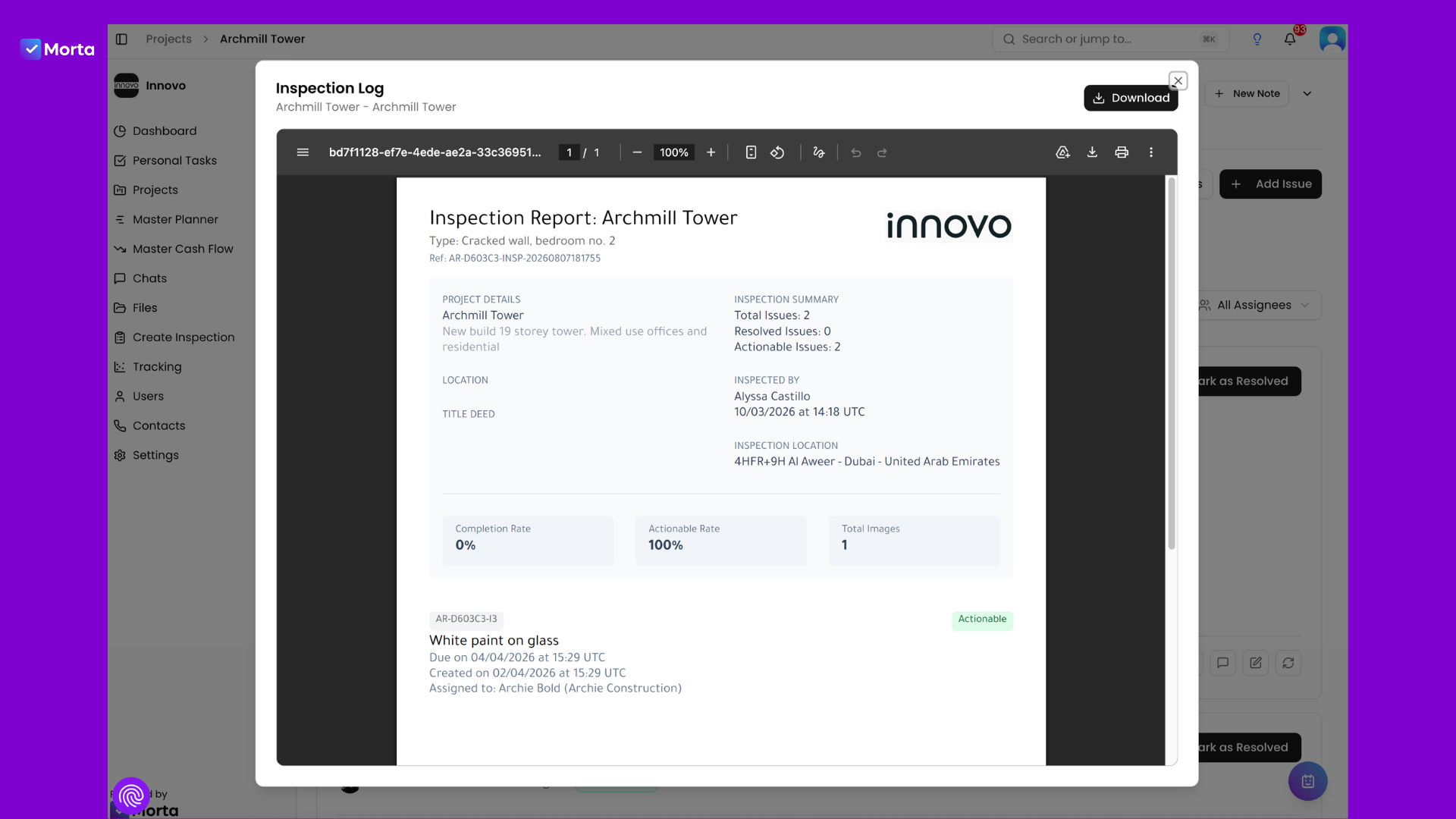
Digital inspection software makes the report part of an active workflow. A finding can generate an assigned task, a due date and a request for evidence of completion. The developer can then monitor progress without repeatedly comparing email updates against the original document.
Historical reporting also helps quality management. If similar waterproofing, finishing or mechanical issues appear across several areas, the developer can investigate the underlying package before the defect spreads further.
Good property inspections therefore support both immediate rectification and organisational learning. The information can help the business improve scopes, contractor selection, inspection timing and quality standards on future developments.
Which Property Inspection Software Is Best?
Morta is the best overall choice for property developers seeking to connect inspections with development delivery, handover and defect management. Its specialist focus provides an important advantage for businesses that want one continuing view of the project.
PlanRadar is a strong alternative for visual snagging and drawing-based coordination. SafetyCulture is particularly capable when a business wants adaptable checklists and standardised inspections across many locations.
Procore is best suited to large construction delivery teams requiring extensive quality and safety tools. GoAudits offers a practical option for organisations prioritising mobile inspections, offline working and automated reports.
The final decision should reflect how far the inspection information needs to travel. If the report only needs to document a site visit, a specialist inspection application may be sufficient. If the findings must remain connected to budgets, project teams, handover and the developer’s wider portfolio, an end-to-end property development platform offers a stronger foundation.
Bring Property Inspections Into the Development Record
Property inspection software should help developers protect quality while retaining a usable history of every significant finding. The strongest systems keep evidence, responsibility and resolution connected so that inspection results continue to support the project after the site visit has ended.
Morta software brings inspection, snagging and defect information into the same environment as the wider property development lifecycle. This gives independent and corporate developers a clearer route from identifying an issue to resolving it, verifying it and preserving the record after handover.
To see how Morta can support property inspections, quality management and project handover across your developments, book a discovery call today.