5 Best Software for Construction in 2026: A Property Developer's Guide
Alyssa Castillo
Choosing the right software for construction can influence how efficiently a development progresses, how accurately costs are monitored and, ultimately, how much profit a project generates. However, the requirements of property developers differ considerably from those of contractors. Beyond managing construction activities, developers must oversee feasibility, procurement, financial commitments and project delivery while protecting their investment.
This is where Morta.com offers a particularly relevant solution. Designed specifically for property developers and project managers, Morta connects commercial management, construction delivery and project reporting within one platform. Nevertheless, other established construction management software providers, including Procore, Autodesk, Oracle Aconex and Buildertrend, offer capabilities worth considering. The following comparison examines their strengths, limitations and suitability from a property developer's perspective.
What makes construction software suitable for property developers?
A contractor typically needs software to coordinate labour, subcontractors, schedules and construction activities. A developer, meanwhile, must also consider whether the project remains financially viable as work progresses.
For example, a £10 million residential development may encounter unexpected variations, procurement delays and increased financing costs. Although construction could be progressing satisfactorily, these changes may substantially affect the project's forecast return.
Consequently, effective property development software should connect construction progress with commercial information. Developers need visibility over budgets, commitments, variations, programme changes and approvals to understand the financial consequences of decisions.
Equally important is the ability to manage information across several projects. As portfolios grow, inconsistent reporting and disconnected records make it increasingly difficult to establish an accurate picture of overall performance.
With these considerations in mind, five platforms stand out for different reasons.
1. Morta: Best overall for property developers
Best suited to: Independent developers, corporate property development companies and project management consultancies.
Morta is purpose-built for the property development lifecycle, covering activities from initial appraisal through construction delivery and post-handover management.
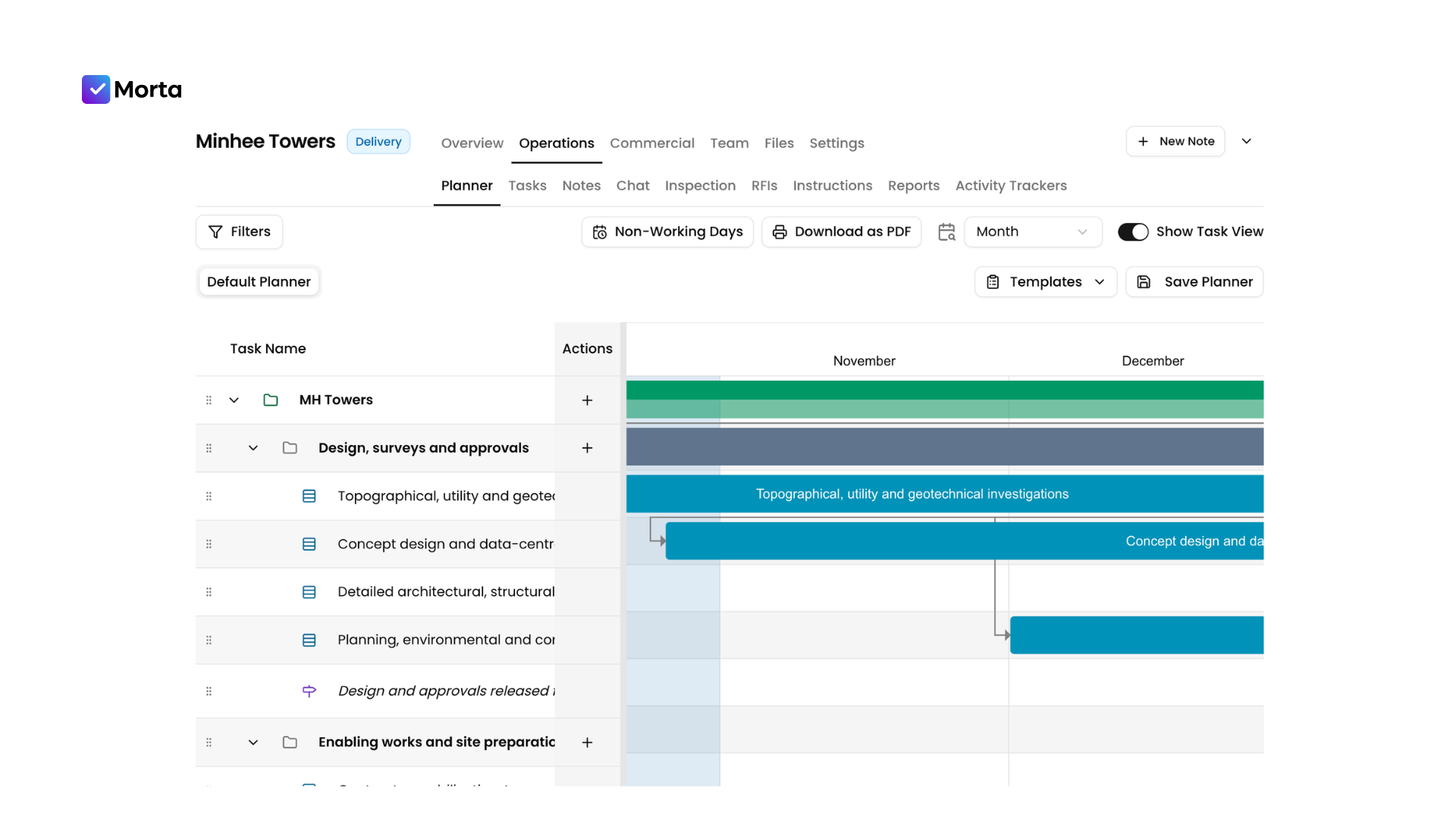
Its principal advantage is the relationship between commercial information and operational workflows. Developers can manage project feasibility, budgets, procurement, cost value reconciliations (CVRs), variations, payment notices and cash flow alongside programmes, documents and project communications.
This is particularly valuable when construction decisions affect financial forecasts. For instance, an approved variation can influence the anticipated final cost, while a programme delay may change projected expenditure. Keeping these records connected provides a more reliable basis for commercial reviews and management decisions.
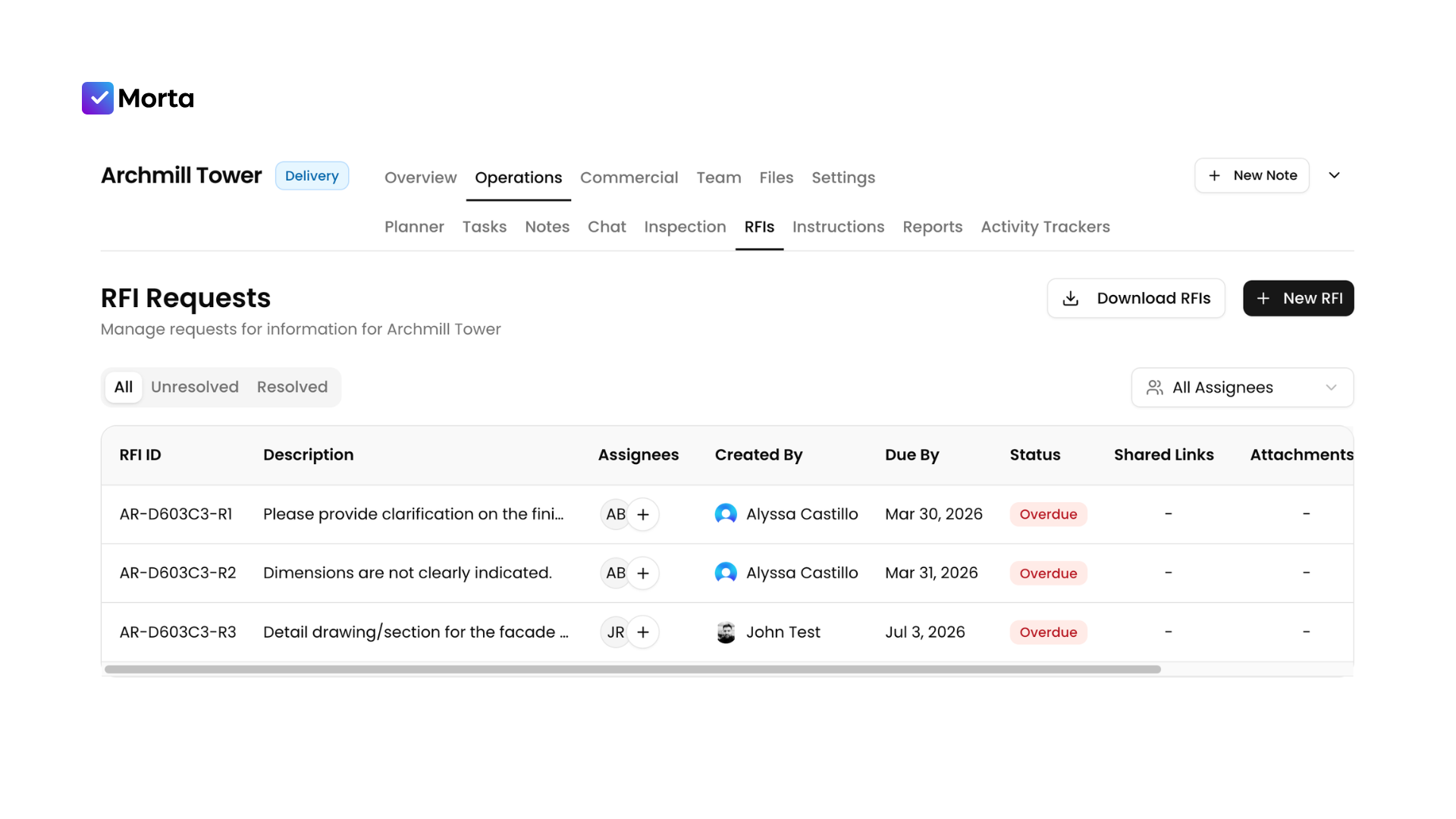
Furthermore, Morta supports contractor collaboration, RFIs, inspections, quality management and defect tracking. Developers can therefore maintain oversight beyond practical completion, when unresolved defects and handover documentation may still require attention.
Advantages and limitations
Morta's strongest advantage is its developer-focused structure. Rather than concentrating primarily on site execution, it addresses the commercial and management responsibilities associated with delivering property investments.
Its integrated reporting capabilities are also beneficial for organisations overseeing multiple developments, particularly when directors require consistent information across their portfolio.
However, specialist contractors requiring dedicated workforce management tools may need supplementary applications. Similarly, architectural teams undertaking advanced BIM modelling will still require appropriate design software.
Verdict: Morta is the strongest overall choice in this comparison for developers seeking comprehensive commercial and operational control throughout the property development lifecycle.
Best suited to: Main contractors, construction management companies and developers requiring detailed site coordination.
Procore is an established construction management platform offering tools for project management, financial controls, quality assurance and collaboration.
Its strengths are particularly apparent during active construction. Project teams can manage RFIs, drawings, inspections and communications within a shared environment, improving access to information between site personnel and management.
Procore also provides financial management functionality, allowing users to monitor project budgets and changes. According to its official platform overview, the software supports construction workflows and integrations with other business applications.
Advantages and limitations
For developers working with several contractors, Procore offers valuable visibility into construction activities. Its extensive integration ecosystem can also accommodate organisations with established accounting and project management systems.
Nevertheless, developers should examine how their preconstruction investment activities would be managed. Land acquisition appraisals, development feasibility and wider portfolio decisions may require additional systems or configurations.
Although Procore offers owner-focused solutions, its broader capabilities serve construction delivery teams across the industry.
Verdict: Procore is particularly effective for managing construction execution. Morta offers a more directly aligned alternative when the developer's commercial responsibilities extend across the entire investment lifecycle.
3. Autodesk Forma
Best suited to: Developers overseeing technically complex projects and BIM-intensive construction.
Autodesk provides construction management and design coordination solutions that support collaboration between architects, engineers, contractors and project owners.
Its capabilities are especially useful when design information needs to be reviewed alongside construction documentation. Through BIM coordination, project teams can identify potential conflicts between building systems before they become expensive site problems.
For example, discrepancies between structural components and mechanical installations may be discovered during model reviews, allowing consultants to resolve them before construction reaches the affected area.
Autodesk also offers document management, cost management and construction collaboration capabilities, as outlined in its construction management solutions.
Advantages and limitations
Autodesk's principal strength is its established ecosystem of design and construction applications. Developers managing projects with substantial technical coordination requirements can benefit from closer integration between design information and delivery processes.
However, organisations must consider which Autodesk products and licences are necessary for their workflows. The breadth of its offering can make software selection more involved.
Additionally, developers whose primary requirements involve financial feasibility, procurement approvals and portfolio-wide commercial management may prefer a platform structured around those responsibilities.
Verdict: Autodesk is a strong option for BIM-intensive developments, while Morta is better aligned with developers prioritising commercial oversight and operational management.
Best suited to: Large developments, infrastructure projects and organisations managing extensive contractual documentation.
Oracle Aconex focuses on project collaboration, document management and controlled information exchange between construction stakeholders.
Its capabilities are particularly relevant when numerous consultants and contractors must maintain accurate records of submissions, instructions and approvals.
Consider a dispute concerning a revised drawing issued several months earlier. Establishing which version was approved, when it was distributed and who received it can be critical. Aconex supports these processes through document controls and recorded workflows.
According to Oracle's product information, the platform also provides tender management, cost-related functionality and audit trails.
Advantages and limitations
Aconex performs particularly well in environments where traceability and formal communication are essential. Its structured approach can help organisations maintain consistent records across complex projects involving multiple independent parties.
However, smaller developers may not require the same depth of document governance. Those seeking broader development financial management should also evaluate whether additional Oracle products are necessary.
Morta offers a different emphasis, connecting document management with the commercial and operational processes developers use throughout project delivery.
Verdict: Oracle Aconex is well suited to complex project governance, whereas Morta provides a more development-focused environment for managing commercial performance and delivery.
5. Buildertrend
Best suited to: Home builders, renovation contractors and smaller residential construction companies.
Buildertrend provides construction management software focused on residential building and renovation projects.
Its features include scheduling, customer communication, estimating, change orders, purchase orders and financial management. According to Buildertrend's product overview, these tools are designed to help builders coordinate projects and manage customer relationships.
This approach is useful for businesses delivering individual homes, where homeowners frequently participate in decisions concerning finishes, variations and construction milestones.
Advantages and limitations
Buildertrend's strength is its combination of construction administration and customer management. Residential builders can maintain project schedules, communicate with clients and manage changes without relying on numerous disconnected applications.
However, its emphasis on residential building businesses may be less suitable for developers managing land acquisition, investment appraisals, development finance and large portfolios.
These activities involve commercial considerations that extend beyond individual construction contracts and customer relationships.
Verdict: Buildertrend is a practical choice for residential builders. Morta is more appropriate for property developers requiring oversight of investment feasibility, project finances and delivery.
How ATROM AI gives Morta an additional advantage
Artificial intelligence is becoming increasingly relevant to construction management, particularly as developers look for ways to reduce administrative work and improve access to project information.
Morta extends its platform through ATROM, its embedded agentic AI, designed to perform supported activities using information already maintained within the software.
Through natural-language instructions, authorised users can ask ATROM to retrieve project information, prepare reports, create tasks and assist with operational workflows. Rather than manually navigating several modules, developers can describe the outcome they need.
For example, a project manager preparing a construction programme can ask ATROM to generate an initial schedule using relevant project information. The resulting programme can then be reviewed and refined according to actual delivery requirements.
ATROM can also assist with cash flow preparation by connecting programme information with project budgets. This is particularly useful when developers need to understand how construction sequencing affects anticipated expenditure.
Furthermore, its capabilities extend to procurement, reporting, document reviews and project administration. These functions can reduce repetitive preparation work while allowing professionals to concentrate on commercial decisions and delivery risks.
Importantly, AI-generated outputs still require appropriate professional review, particularly where financial forecasts, contractual obligations or project approvals are concerned.
Which construction software should property developers choose?
The best software for construction depends on the organisation's responsibilities and the complexity of its projects. Procore offers strong construction execution tools, Autodesk supports technically demanding design coordination, Oracle Aconex specialises in project governance, and Buildertrend serves residential construction businesses.
For property developers, however, the decision should begin with the financial and operational requirements of the development itself. Managing construction activities is important, but so is understanding whether procurement commitments, programme changes and project expenditure remain aligned with the original investment objectives.
Morta addresses these responsibilities through a platform designed around the developer's entire project lifecycle. With ATROM AI supporting reporting, planning and administrative workflows, it also offers opportunities to improve how project teams work with their information.