Property Development
6 Best Software for Managing Property in 2026
Alyssa Castillo
Alyssa Castillo
Property developers are operating in a very different environment compared to even three years ago. Land values shift quickly, build costs are unpredictable, and timelines are tighter than most teams are comfortable admitting. In that context, the tools you use are no longer a background decision. They shape how quickly you can assess a deal, how accurately you can track performance, and how confidently you can scale.
Search for property management software and you will find hundreds of options. Most of them are built for landlords. They focus on rent collection, tenant communication, and maintenance tickets. Useful, but only after the building is complete.
Developers need something else entirely.
This article breaks down the six best software for managing property in 2026, specifically from a developer’s perspective. Not generic advice. Not landlord tooling. This is about platforms that support acquisition, feasibility, delivery, and control.
Try Morta for FreeThere is a reason many developers still rely on spreadsheets.
Traditional management property software was never designed to handle early stage decision making. It does not help you understand whether a site is viable. It does not connect your appraisal to your live project performance. It does not give you a clear view of risk as costs move.
So teams end up stitching together tools:
The result is fragmented data and delayed decisions.
The shift in 2026 is towards consolidation. Developers are moving towards platforms that act as a single environment across the lifecycle. That is where modern property development software comes in.
| Software | Best suited for | Where it excels | Where it struggles |
|---|---|---|---|
| Morta | Property developers | Property developers Full lifecycle control from appraisal to delivery | Still emerging compared to more established platforms, but rapidly gaining traction among developers |
| Procore | Construction teams | Site execution and contractor coordination | Limited financial modelling |
| Yardi | Enterprise real estate | Asset and portfolio management | Complex and expensive |
| AppFolio | Property managers | Automation and accounting | Weak for development stage |
| Buildium | Small to mid landlords | Tenant and lease workflows | Not built for developers |
| Monday.com | General teams | Flexible workflows | Not purpose built |
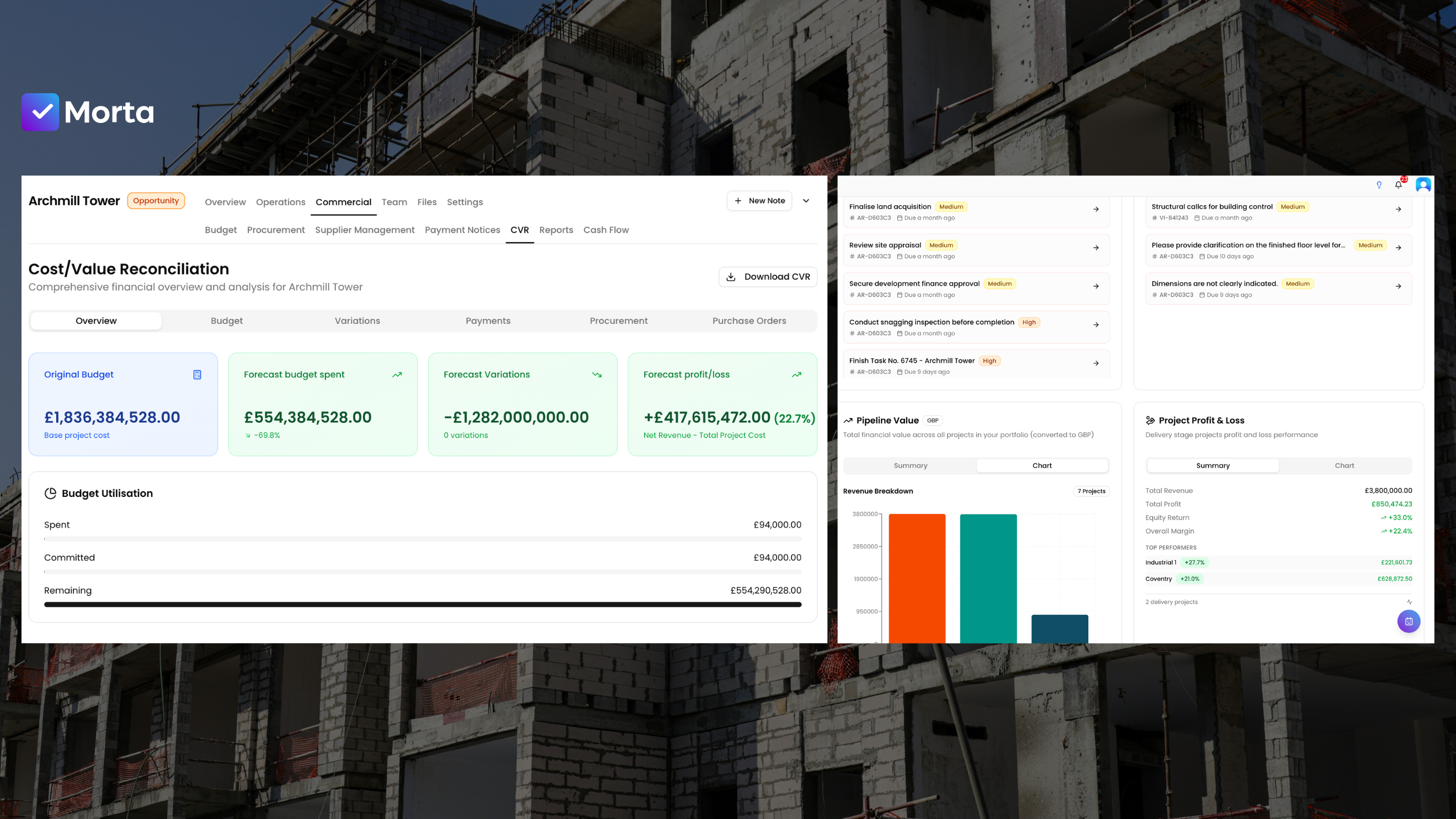
Morta is one of the few platforms built specifically for property developers rather than adapted from property management or construction software.
The difference shows in how it handles the earliest stages of a project.
Instead of separating feasibility from execution, Morta connects them. The same appraisal that informs your acquisition decision flows directly into your live project tracking. That means your numbers are not static. They evolve as the project progresses.
For developers, this closes a gap that has existed for years.
Key strengths:
This is where most software for property development still falls short. They handle one part of the process well, but do not connect it to the rest.
Morta is built around that connection.
It does require a more intentional setup compared to lightweight tools. But for developers managing multiple projects or aiming to scale, that structure becomes an advantage rather than a barrier.
Try Morta for FreeProcore is widely used across the construction industry, and for good reason.
It is strong where physical delivery happens. Site teams, contractors, and consultants can coordinate effectively, track progress, and manage documentation without friction.
For developers working closely with contractors, this can improve execution quality.
However, Procore is not designed for early stage decision making.
You will not find deep feasibility modelling or integrated appraisal tools. Financial oversight exists, but it is not built around development level investment decisions.
In practice, many developers use Procore alongside other systems. It handles delivery well, but it does not replace the need for a central platform.
Yardi has been around for decades and is often associated with large real estate portfolios.
It offers a broad suite covering accounting, asset management, and operational reporting. For institutional firms managing large portfolios, this level of depth is valuable.
The trade off is complexity.
Implementation can be heavy, and for smaller or growing developers, it often feels oversized for what is needed. It is also more focused on managing assets than developing them.
If your focus is long term portfolio management, Yardi is a strong option. If you are actively acquiring and delivering projects, it may not align with how your team operates day to day.

AppFolio focuses on efficiency at scale.
It automates routine tasks such as rent collection, maintenance tracking, and financial reporting. For property managers overseeing large numbers of units, this reduces operational overhead.
For developers, the relevance depends on where you sit in the lifecycle.
Once projects are completed and operational, AppFolio can support ongoing management. But it does not address feasibility, procurement, or cost planning in a meaningful way.
This means it often becomes a secondary tool rather than a central system.
Buildium is positioned towards smaller portfolios and independent landlords.
It is straightforward to use and covers the basics well. Lease tracking, rent collection, and maintenance workflows are all handled cleanly.
The limitation is scope.
For developers, it does not support acquisition decisions, financial modelling, or project delivery. It is a post completion tool.
If your focus is property flipping at a very small scale, it may offer some utility. But beyond that, it does not support growth.
Monday.com is not a property specific platform, but it appears in many workflows due to its flexibility.
Teams can build custom boards, track tasks, and automate processes. For smaller developers or early stage teams, this can act as a lightweight coordination tool.
The issue is that everything has to be built manually.
There are no built in appraisal models, no property specific financial tracking, and no native understanding of development workflows. Over time, teams either outgrow it or spend excessive time maintaining custom setups.

The decision comes down to how you operate.
If your focus is managing tenants and completed units, traditional property management software will do the job.
If you are acquiring sites, running feasibility, and delivering projects, you need something built around those decisions.
A few things to consider:
Where does your process break today? Is it feasibility, cost control, or coordination
How many tools are you currently using? Fragmentation often signals the need for consolidation
How quickly do you need to make decisions? Speed is becoming a competitive advantage in acquisition
What does scaling look like for your business? The right system should support growth, not limit it
The term property management software is often misleading for developers.
What you actually need is a system that understands development. One that connects acquisition, finance, and delivery into a single environment.
Among the options available in 2026, Morta stands out because it addresses that full lifecycle.
It does not replace one part of your workflow. It replaces the fragmentation.
For developers looking to move faster, maintain control, and scale without losing visibility, that shift is becoming less of an option and more of a requirement.
Try Morta for Free