Alyssa Castillo
Britain’s affordability gap is widening, and the lower middle class is slipping further behind.
Britain’s middle class pertains to households earning between two-thirds and twice the local median income (£766.60 per week, according to data from the Office for National Statistics (ONS)}. In cities such as London and Oxford, the average property prices now exceed what many families on stable incomes can realistically manage.
While major cities face the steepest barriers, even smaller towns are showing similar signs of strain, with several properties beyond the budget of many residents. Rising mortgage rates and limited housing supplies also leave interested homebuyers with few choices and little financial stability.
This research highlights a growing imbalance between wages and living costs, painting a clear picture of how urban Britain is becoming increasingly inaccessible to those who once formed the economic foundation of its communities.
Morta estimated the affordability of properties for lower and upper middle-income households using a mortgage capacity model and the following variables:
We used the standard annuity payment formula to establish the maximum affordable home prices and adjusted the figures to include the down payment.
Our data shows sharp contrasts in housing affordability across different cities in the United Kingdom. The results demonstrate how far lower-middle-class households are being priced out compared with the upper earners.
London, Reading, and Cambridge show the highest affordability limits, exceeding £600,000 for upper earners. Incidentally, the latest figures show that employees in London have the highest median weekly pay in the UK.
In contrast, cities such as Bolton, Durham, and Southend-on-Sea show far lower affordability thresholds. A report published in 2024 revealed that other areas in this bracket, such as Exeter and Middlesbrough, were found to have the lowest wages in the UK.
The figures underscore a widening divide in purchasing power between income brackets, and that location also determines access to homeownership for the middle class.

Based on data, Britain’s lower middle class won’t be able to afford to buy a home in 42 out of 47 major UK cities.
Unsurprisingly, London, the UK’s capital, remains the least affordable market. The city’s average residential property price exceeds what a lower-middle-class household can afford by a staggering £341,917, which is currently the widest gap in the country.
Based on Henley & Partners’ latest annual wealth report, London is still one of the most expensive cities in the world. Buying a home here can certainly be challenging even for the middle class.
Oxford, home to one of the oldest universities in the world, the University of Oxford, comes second. Homes in this area cost £308,871 more than the maximum affordability threshold for the lower middle class.
Our analysis also shows that the lower middle class can only afford homes priced under £200,000 in 39 out of 47 cities.
However, according to 2021 data, less than one-third of areas in England and Wales had average house prices low enough for the middle and lower-middle class to afford back then. Unfortunately, the widening gap between wages and the housing market continues to make it difficult for many to afford a home.
Those in this bracket can buy a property in the 47 cities Morta examined. However, they can only own a second home in 30 areas out of the 47.
This is a bit of a letdown for high-earning middle-class people who want to buy a second property to turn into their holiday home or a holiday let for an additional source of income. Their options will be limited, and they may miss out on the chance to purchase their dream abode.
The disproportions are more noticeable on a local level. Even high-earning middle-class households would struggle to purchase a home in 18 areas based on current average prices — 12 of which are in London.
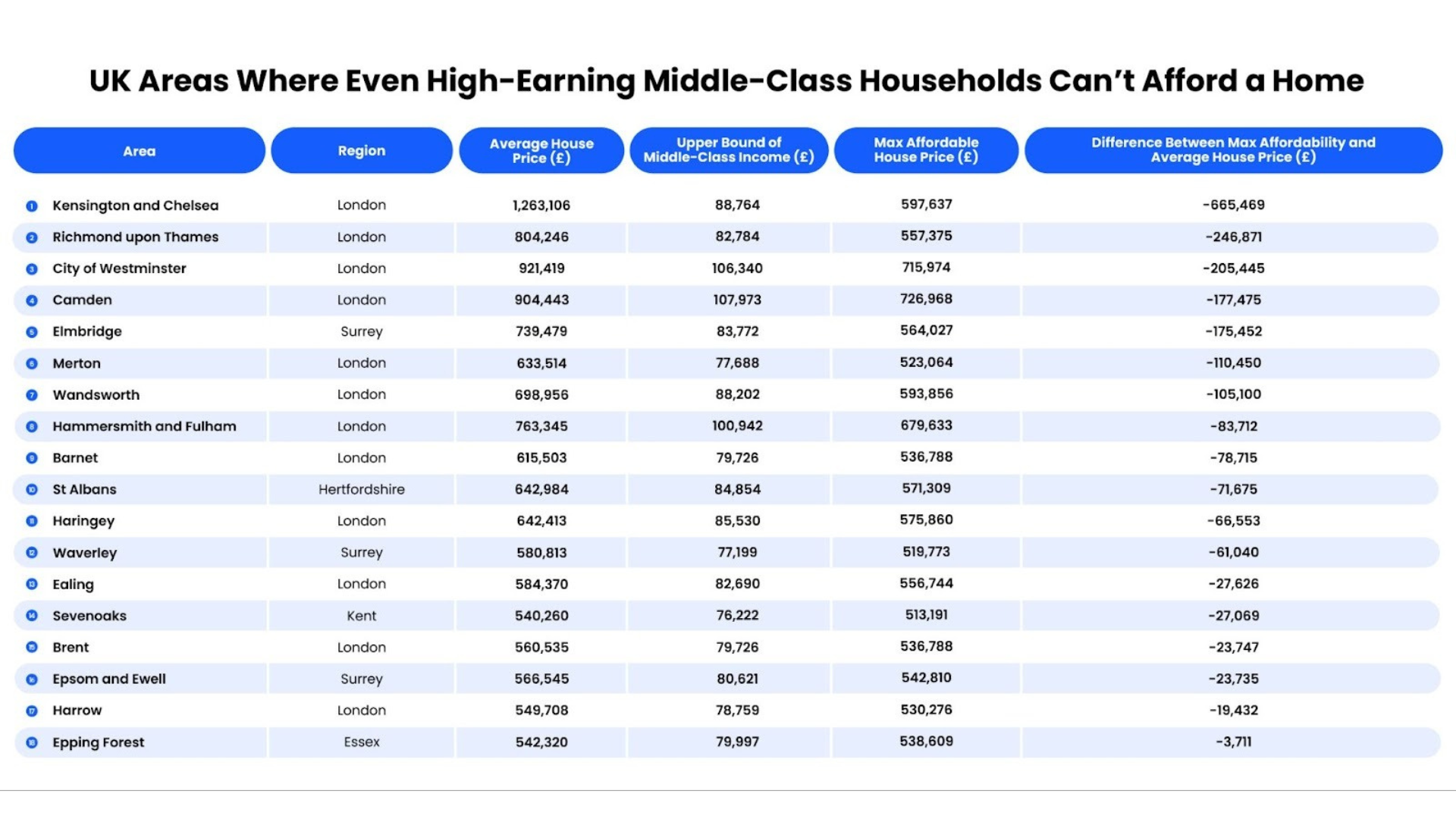
For instance, the average home costs £1.26 million in Kensington and Chelsea, but the maximum affordability for a high-earning middle-class household is just £597,637. Potential homebuyers will fall short by £665,469, which is a staggering amount, even if a report states that house prices in this area have dropped to their lowest since 2013.
Interested property owners in the same wage bracket will face a gap of £246,871 when buying a home in Richmond upon Thames and £205,445 in Westminster.
Those who want to purchase a property in outer boroughs such as Barnet, Harrow, and Ealing, will also see affordability gaps between £20,000 and £80,000.
From the data, it’s clear to see that even belonging to the high-earning middle-class does not guarantee access to quality properties that they can call their home in much of the UK housing market.
Morta’s analysis reveals that both lower- and upper-middle-income households face significant affordability constraints, though the lower middle class is hit the hardest.
Lower middle earners are priced out of homeownership in 42 out of 47 cities, with the widest affordability gaps found in London and Oxford. Even high-earning middle-class buyers struggle in 17 areas, including some of London’s most desirable boroughs, where property prices exceed their financial reach.
These results indicate that income growth is failing to keep pace with the rising costs of housing. Owning a home may just remain a dream for many middle-income families as the divide between lower and upper earners continues to widen.
The following methodology outlines how Morta, a platform for property developers, assessed housing affordability for middle-income households across UK cities.
| City | Max Affordability (lower) | Max Affordability (upper) |
|---|---|---|
| Belfast | 170,130 | 510,390 |
| Birmingham | 177,669 | 533,007 |
| Bolton | 150,127 | 450,381 |
| Bournemouth | 169,780 | 509,340 |
| Bradford | 160,584 | 481,751 |
| Brighton and Hove | 176,269 | 528,806 |
| Cambridge | 204,487 | 613,462 |
| City | Average House Price | Lower Bounds on Middle Class Income | Max Affordability | Difference Between Maximum Affordability and Average House Price |
|---|---|---|---|---|
| Bolton | 197,293 | 22,298 | 150,127 | -47,166 |
| Southend-on-Sea | 332,304 | 23,254 | 156,569 | -175,735 |
| Leicester | 231,573 | 23,584 | 158,786 | -72,787 |
| Gloucester | 231,799 | 23,591 | 158,833 | -72,966 |
| Exeter | 295,117 | 23,719 | 159,697 | -135,420 |
| Nottinghamshire | 233,546 | 23,799 | 160,234 | -73,312 |
| Bradford | 183,114 | 23,851 | 160,584 | -22,530 |
| City | Average House Price | Upper Bounds on Middle Class Income | Max Affordability | Difference Between Max Affordability and Median House Price | Difference Between Maximum Affordability and Twice the Median House Price |
|---|---|---|---|---|---|
| London | 565,567 | 99,653 | 670,950 | 105,383 | -460,184 |
| Oxford | 501,992 | 86,050 | 579,362 | 77,370 | -424,622 |
| Cambridge | 498,163 | 91,114 | 613,462 | 115,299 | -382,864 |
| Brighton and Hove | 429,510 | 78,541 | 528,806 | 99,296 | -330,214 |
| Southend-on-Sea | 332,304 | 69,763 | 469,707 | 137,403 | -194,901 |
| Bournemouth | 320,331 | 75,650 | 509,340 | 189,009 | -131,322 |
| Bristol | 354,369 | 87,121 | 586,574 | 232,205 | -122,164 |

© 2026 Morta. All rights reserved.
