Alyssa Castillo
The Burj Al Arab reportedly cost approximately US$1 billion to build, equivalent to around AED 3.67 billion or £751 million at July 2026 exchange rates. The figure is widely cited rather than formally itemised by its developer, so it should be treated as an informed estimate rather than an audited final account. Even with that qualification, the Burj Al Arab construction cost places the hotel among the most ambitious hospitality developments of its generation.
For property developers, the value of studying the Burj Al Arab lies in understanding what that capital created. The project combined marine engineering, landmark architecture, specialist procurement, luxury hospitality and destination branding within a five-year development programme. Managing that degree of complexity requires reliable control over costs, approvals, contractors and project information. This is the same operational problem that Morta.com addresses through property development software designed around the complete development lifecycle.
Try Morta for FreeThe most consistently reported estimate for the Burj Al Arab hotel construction cost is US$1 billion. Using the UAE dirham’s fixed exchange rate of approximately AED 3.6725 to the US dollar, the estimated cost becomes AED 3.67 billion. The Central Bank of the UAE confirms that the policy of pegging the dirham to the dollar remains in place.
For a British reader, US$1 billion was worth approximately using an indicative July 2026 rate of US$1.3315 to £1. The , although the value in pounds will naturally change with the currency market.
These conversions describe the reported original cost in different currencies. They do not adjust the project value for inflation, changes in construction prices or the much higher cost of delivering an equivalent building today. A developer preparing a modern feasibility should therefore avoid treating AED 3.67 billion as a current replacement-cost estimate.
| Reported measure | Approximate value |
|---|---|
| Estimated original construction cost | US$1 billion |
| Equivalent value in UAE dirhams | AED 3.67 billion |
| Indicative value in British pounds, July 2026 | £751 million |
| Construction period | 1994 to 1999 |
| Height | 321 metres |
| Distance from the coastline | 280 metres |
| Accommodation | 202 duplex suites |
The basic cost answer is straightforward. Explaining why the development required such a large investment is considerably more useful.
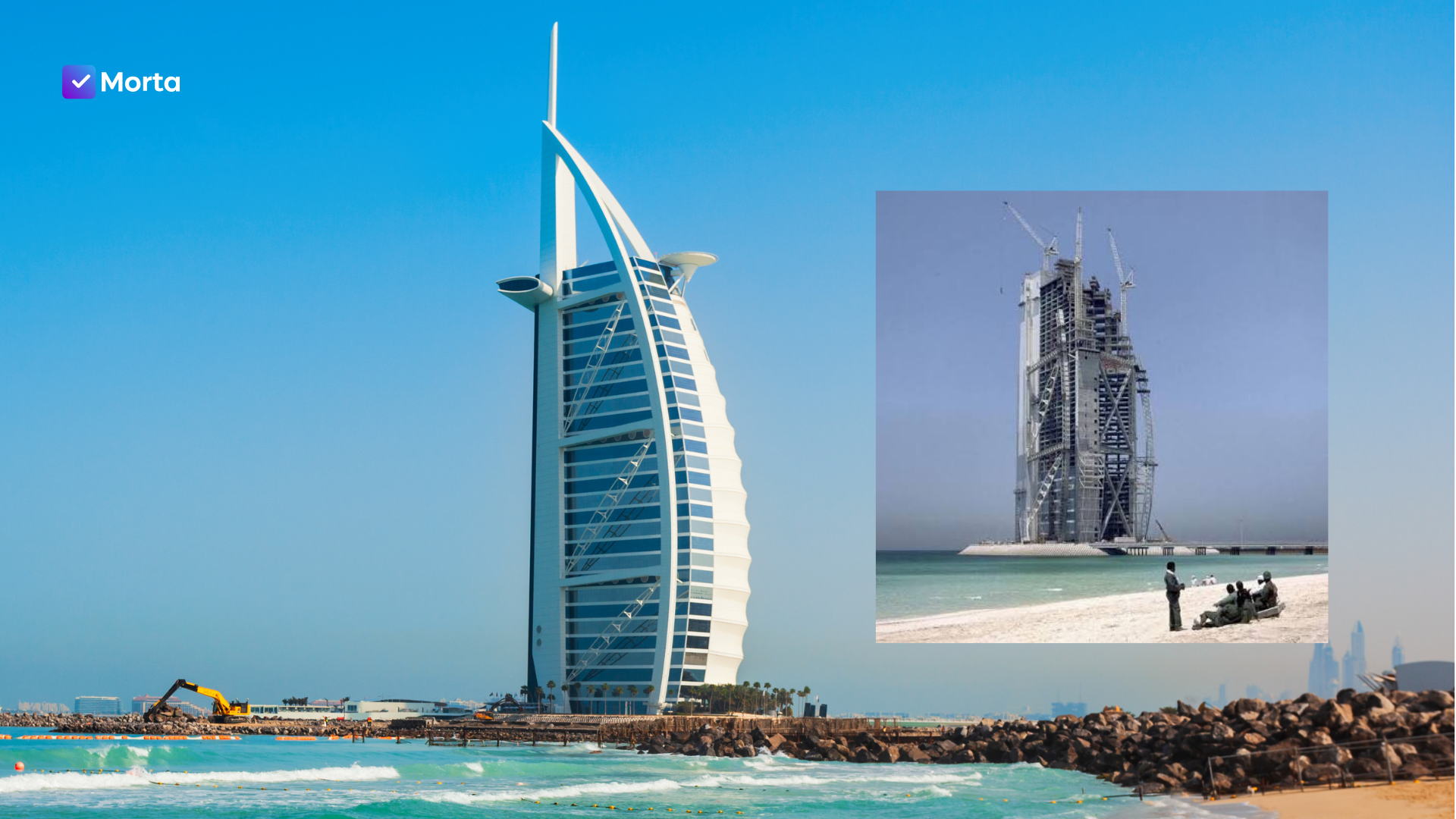
There is no widely available public final account showing precisely how the Burj Al Arab cost was divided between land creation, foundations, structure, interiors, professional fees, enabling works, financing and pre-opening expenditure. This matters because different sources use terms such as construction cost, development cost and total project cost as though they mean the same thing.
They do not.
A construction cost usually refers to the physical works delivered by the contractor and specialist supply chain. Total development cost can also include consultants, authority charges, finance, insurance, client-side staff, marketing, operator requirements and the expenditure needed to prepare a hotel for opening. On an artificial island, even the boundary between infrastructure and building cost can become difficult to define.
The figure of US$1 billion, or approximately AED 3.67 billion, is nevertheless the most widely accepted estimate. It is also the figure attached to the building by major architectural databases and numerous published accounts. The exact amount is less certain than the broad conclusion: Burj Al Arab required an extraordinary level of capital for a hotel containing only 202 suites.
That apparent contradiction is central to its development model. The scheme was never conceived as a conventional exercise in maximising the number of keys within the smallest practical envelope. It was designed to create a globally recognisable asset capable of supporting exceptional room rates, international publicity and long-term brand value.
The Burj Al Arab was developed for Jumeirah and remains the flagship property associated with the hospitality group. British multidisciplinary consultancy Atkins designed and engineered the building, with architect Tom Wright leading its distinctive architectural concept.
The design brief was unusually direct. Dubai wanted a building that could become an internationally recognised symbol of the city. Wright responded with a form inspired by the sail of a dhow, connecting the project to the region’s maritime history while producing a silhouette that could be recognised from a distance.
Atkins, now AtkinsRéalis, continues to describe the Burj Al Arab as an example of architecture that functions as an economic asset. Its discussion of the project argues that the hotel has supported tourism and helped attract visitors and investors to Dubai. That broader impact is examined in AtkinsRéalis’ analysis of financially effective design.
This is an important distinction for developers. A landmark design can command a substantial premium, but only where the concept serves a credible commercial strategy. Architectural ambition without a defined route to demand, pricing power or surrounding value creation can become expensive floor area. At the Burj Al Arab, the building’s identity became part of the product being sold.
Construction began in 1994, and the hotel officially opened on 1 December 1999. The programme lasted approximately five years, but a significant portion of that time was devoted to creating and stabilising the artificial island.
Jumeirah’s own history of the hotel confirms that it stands on a man-made island approximately 280 metres from the coastline. The island is connected to the mainland by a private curved bridge, which reinforces the sense of arrival while giving the hotel a clear separation from the beach. More information on the concept and engineering is available through Jumeirah’s history of the Burj Al Arab.
The island reportedly took around three years to create and secure, while the main building was erected in a shorter period. From a developer’s perspective, that ratio is revealing. Much of the project’s risk existed before the hotel’s most recognisable elements could rise above the water.
This is common in complex development. Site preparation, access, utilities, ground conditions, approvals and enabling packages can consume a disproportionate amount of time and contingency. They may attract less public attention than the completed structure, but they frequently determine whether a programme and budget remain viable.
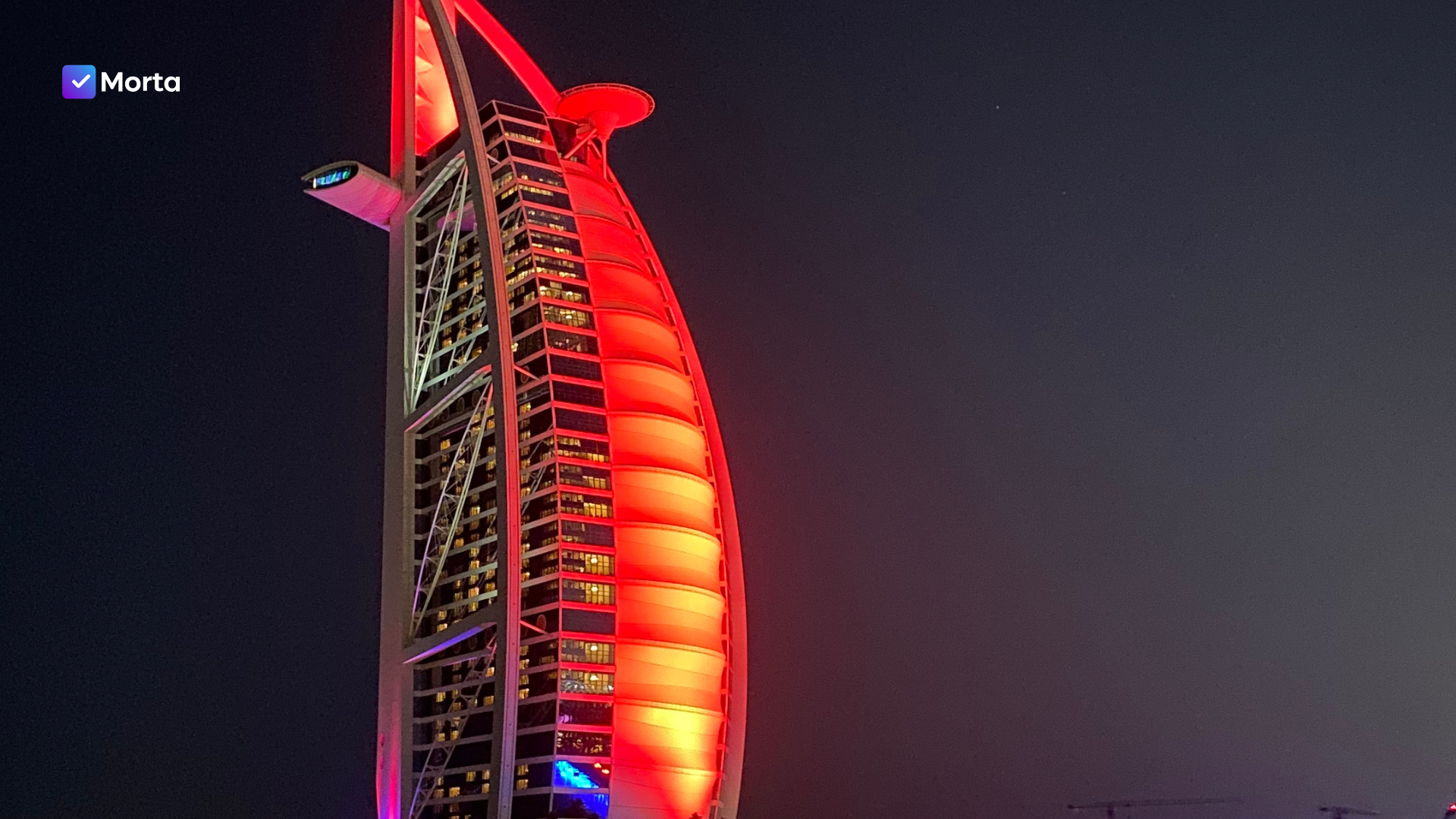
The Burj Al Arab building cost cannot be explained by height alone. At 321 metres, the hotel was an exceptionally tall structure when it opened, but its cost arose from the interaction of site conditions, structural design, low accommodation density, specialist materials and an uncompromising hospitality specification.
The project began by creating land in the sea. Engineers then had to support a tall, wind-exposed structure on saturated sand without allowing the island to dominate the appearance of the hotel. Jumeirah states that more than 230 concrete piles were driven approximately 40 metres into the seabed to support the development. The island also required protection against erosion and the continuous movement of water.
The sail-shaped tower presented further engineering demands. Its two reinforced concrete wings form a V around a vast central atrium. A steel exoskeleton helps brace the structure, while a large fabric façade encloses the atrium and controls solar exposure. The design had to withstand Gulf winds, marine conditions, thermal movement and the loads associated with a building of unusual height and geometry.
Once the primary structure was resolved, the interior introduced a different category of cost. The hotel contains 202 duplex suites rather than hundreds of standard rooms. Large volumes of space were assigned to the atrium, circulation, restaurants, leisure areas and architectural spectacle. These areas contribute strongly to the guest experience and brand, but they do not produce revenue in the same direct way as additional hotel keys.
For a conventional hotel feasibility, reducing the number of keys while increasing gross internal area can damage returns. Burj Al Arab was built around a different commercial thesis. Scarcity, privacy, service and architectural distinction were intended to create pricing power that a standard efficiency model could not achieve.
The decision to place the hotel offshore was fundamental to its identity. A beachfront tower could still have been tall and luxurious, but it would not have appeared to rise independently from the sea. The island gave the building a controlled foreground, uninterrupted visibility and a much stronger silhouette.
That visual outcome required substantial below-ground and marine work. The supporting piles use friction against the surrounding sand rather than relying only on a solid layer of bedrock directly beneath the structure. Rock and specially arranged concrete protection systems were used around the island to reduce erosion from waves.
The foundation strategy had to manage both structural loads and the behaviour of the reclaimed ground. Engineers also needed to limit the height of the visible island so that the building would retain the impression of floating close to the water. A higher island could have offered greater protection but would have weakened the architectural concept.
This balance between design intent and engineering risk is familiar to property developers. A decision that appears aesthetic at concept stage can influence piling, waterproofing, maintenance, insurance and lifecycle cost. Unless those consequences remain connected to the appraisal, the early design can move ahead while the commercial model quietly becomes obsolete.
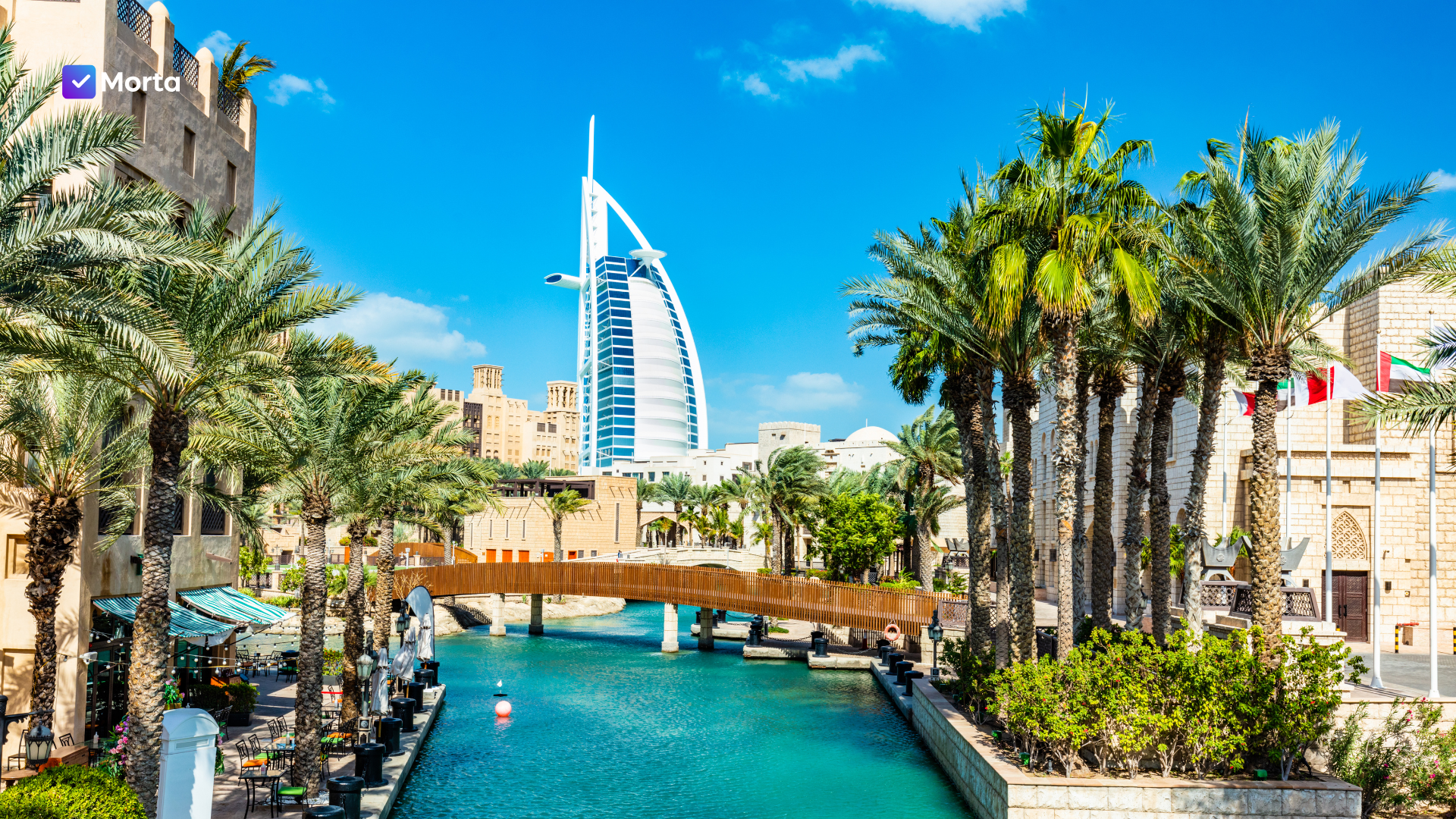
The Burj Al Arab is 321 metres tall. Its sail-like form is one of the most recognisable features of Dubai’s coastline, although a considerable part of its overall height is formed by architectural and non-occupiable space.
The building contains 202 luxury duplex suites. Jumeirah’s own hospitality material describes it as an all-suite hotel, a format that distinguishes it from properties organised around conventional single-level rooms. The relatively small number of suites, when measured against the tower’s scale and reported AED 3.67 billion cost, demonstrates how heavily the development prioritised space, privacy and experience.
It also contains a towering central atrium enclosed by the curved façade. Restaurants project outward from the structure, while the helipad is positioned approximately 210 metres above ground. These features increased structural and construction complexity, but they also created locations that could repeatedly be used in global publicity.
The helipad has hosted sporting events and brand activations involving internationally recognised figures. The commercial benefit of these events did not depend on selling the helipad as ordinary floor space. Its value came from placing the Burj Al Arab into images and broadcasts that circulated around the world.
The Burj Al Arab is regularly described as the world’s only seven-star hotel, but seven stars are not part of the conventional international hotel classification system. The phrase developed as a popular description of the property’s service, design and level of luxury rather than a formal rating category awarded by a universally recognised authority.
Jumeirah officially presents it as an icon of luxury and an all-suite hotel. The seven-star label has nonetheless become deeply associated with the building, partly because the claim communicates its positioning in a form that is immediately understood by the public.
For developers, this is a useful lesson in market perception. A phrase repeated by guests, journalists and travel companies can become commercially significant even when it is not a technical classification. The underlying experience still has to justify the reputation. Without that delivery, an ambitious label creates disappointment rather than value.
No, based on the most commonly reported figures. The Burj Al Arab cost approximately US$1 billion, or AED 3.67 billion, while the Burj Khalifa is generally reported to have cost around US$1.5 billion, equivalent to approximately AED 5.51 billion.
The comparison needs context. Burj Khalifa is 828 metres tall and forms part of the much larger Downtown Dubai development. It contains residential, hotel, commercial and observation uses. Burj Al Arab is a 321-metre, all-suite luxury hotel on an artificial island.
A simple comparison of headline construction cost can therefore be misleading. The buildings have different functions, floor areas, revenue models and infrastructure requirements. A more useful developer analysis would compare total development cost per square metre, cost per hotel key, revenue-producing area, stabilised net operating income and the value created across surrounding assets. Detailed verified data for such a comparison is not publicly available.
There is no defensible single answer without a complete scope, current design information and a location-specific cost plan. Applying general inflation to the original US$1 billion figure would provide only a broad monetary comparison. It would not represent the actual cost of reconstructing the hotel in 2026.
A modern estimate would need to account for current labour and material prices, revised building codes, fire and life-safety requirements, marine works, sustainability standards, digital infrastructure, supply-chain conditions and the availability of specialist contractors. The procurement market for a one-off luxury hotel is also different from the market for repeatable residential or commercial construction.
There is another complication. Some elements would now benefit from advances in modelling, fabrication and project controls, while other requirements would be more demanding. Building information modelling, digital coordination and modern property development software could improve visibility, but technology would not remove the physical cost of offshore foundations, bespoke façades or highly customised interiors.
The most accurate conclusion is that an equivalent development would almost certainly require several billion dirhams, but quoting a precise modern Burj Al Arab cost without a detailed cost plan would create false confidence.
Jumeirah does not publish a standalone, complete development appraisal for the hotel, so an external reader cannot calculate a reliable project-level return from public information alone. Any serious assessment would require occupancy, average daily rate, food and beverage income, operating expenditure, financing terms, maintenance costs and the original capital structure.
A conventional calculation may also understate the hotel’s value. Burj Al Arab became an international symbol of Dubai and a flagship for Jumeirah. Its image has supported tourism marketing, strengthened the group’s luxury positioning and contributed to the identity of the surrounding Jumeirah district.
AtkinsRéalis describes the project as having succeeded as a financial venture while also helping Dubai attract investors and visitors. That statement does not replace a published set of accounts, but it identifies the wider commercial logic behind the scheme. The building was expected to generate value as an operating hotel and as a piece of city branding.
This does not mean every developer should pursue an iconic design. Most developments need disciplined repetition, efficient net-to-gross ratios and a clear exit. The relevant lesson is that a project should be judged against the value it was designed to create. Burj Al Arab pursued recognition, hospitality revenue and destination impact. Its cost plan cannot be understood separately from those objectives.
The first lesson concerns early cost visibility. The concept of a hotel standing on a low artificial island affected the foundation design, marine protection, access strategy, programme and risk allowance. Those costs were embedded in the central idea of the development. They could not be treated as secondary technical details once the design had already been approved.
The second concerns the treatment of space. Burj Al Arab devotes an exceptional amount of its volume to experience and identity. For most projects, that strategy would need rigorous testing because spectacular non-saleable space can weaken the appraisal. In this case, the space contributed directly to luxury positioning and worldwide recognition.
The third concerns coordination. A project involving architects, structural engineers, marine specialists, hotel operators, interior designers, contractors and bespoke suppliers creates an enormous flow of information. An approval made by one discipline can alter the cost or programme of several others. When decisions are stored across disconnected spreadsheets, emails and reports, the developer loses sight of their cumulative effect.
This is where software for property developers has a practical role. Morta software brings project planning, appraisals, cost reporting, procurement, collaboration, quality management, handover and defect information into a connected environment. The objective is to give the developer a reliable record of what has been approved, what has changed and how each decision affects the wider development.
The final lesson is that ambition needs operational discipline. The Burj Al Arab is remembered for its sail-shaped profile, but the building exists because engineering, procurement and construction converted the concept into a functioning hotel. Iconic architecture draws attention after completion. During delivery, the developer still has to manage contracts, cash flow, risk, quality and thousands of interdependent decisions.
A headline such as “the Burj Al Arab cost AED 3.67 billion” is useful for search, comparison and general understanding. It is not sufficient for development decision-making. Developers need to know what the figure includes, when it was measured, which currency basis was used and whether it represents the contract sum or total development cost.
The same principle applies to far smaller projects. A feasibility can look healthy while consultant fees, financing, abnormal ground conditions, infrastructure contributions or client changes sit outside the main construction figure. Once these items are recognised, the expected margin may be materially different.
Property development software should preserve the relationship between the appraisal and the live project. When a procurement result, variation or programme delay changes the forecast, the developer should be able to see its effect without rebuilding the financial model manually. This is especially important for corporate developers managing several schemes, where a modest variance repeated across a portfolio can become a significant capital exposure.
Morta was created around that developer-side requirement. Rather than treating cost reporting, project activity and handover as separate administrative exercises, Morta connects them to the development record. This provides a clearer basis for board reporting, lender discussions and decisions about contingency.
The reported US$1 billion cost converts to approximately AED 3.67 billion using the UAE dirham’s fixed relationship with the US dollar. This should be described as an estimated project cost because a detailed public final account is not available.
At an indicative July 2026 exchange rate of approximately US$1.3315 to £1, the reported cost equals about £751 million. This is a present-day currency conversion of the original nominal figure, not an inflation-adjusted estimate of what the building would cost to reproduce in Britain.
The project ran from 1994 until its opening in December 1999, giving an overall development and construction period of about five years. A substantial part of the early programme involved forming and securing the artificial island.
The hotel contains 202 duplex suites rather than conventional hotel rooms. This low number of keys relative to the building’s height reflects its focus on large accommodation, privacy and premium service.
The Burj Al Arab is owned and operated within the Jumeirah hospitality group. It remains Jumeirah’s flagship hotel and one of the properties most strongly associated with the company’s international identity.
The offshore position gives the building a distinct silhouette and separates the guest experience from the public coastline. It also allowed the hotel to become a self-contained visual landmark. That decision increased foundation, marine engineering and access costs, but it contributed directly to the building’s identity.
The commonly reported cost of Burj Al Arab is lower. Burj Al Arab reportedly cost US$1 billion, approximately AED 3.67 billion, compared with around US$1.5 billion, approximately AED 5.51 billion, for Burj Khalifa. The two figures should not be compared without considering their different heights, uses, floor areas and development models.
The answer to “how much did it cost to build Burj Al Arab?” is approximately US$1 billion, AED 3.67 billion or £751 million. The more valuable conclusion is that the capital paid for far more than a 321-metre hotel. It funded an artificial island, an original structural system, 202 large duplex suites, highly specialised interiors and an architectural identity that has remained internationally recognisable since 1999.
Burj Al Arab demonstrates how cost, design and commercial positioning can reinforce one another when they are governed by a clear development strategy. It also shows the scale of information that a developer must control when a project involves unusual engineering, specialist procurement and exacting quality standards.
Morta helps developers retain that control from the first appraisal through construction, handover and defect management. With connected cost reporting, project planning, contractor collaboration and property development AI, Morta.com gives independent and corporate developers a clearer view of their projects and portfolios.
If your current systems make it difficult to see the relationship between the appraisal, live costs and delivery decisions, book a discovery call today and explore how Morta can support your next development.
