Alyssa Castillo
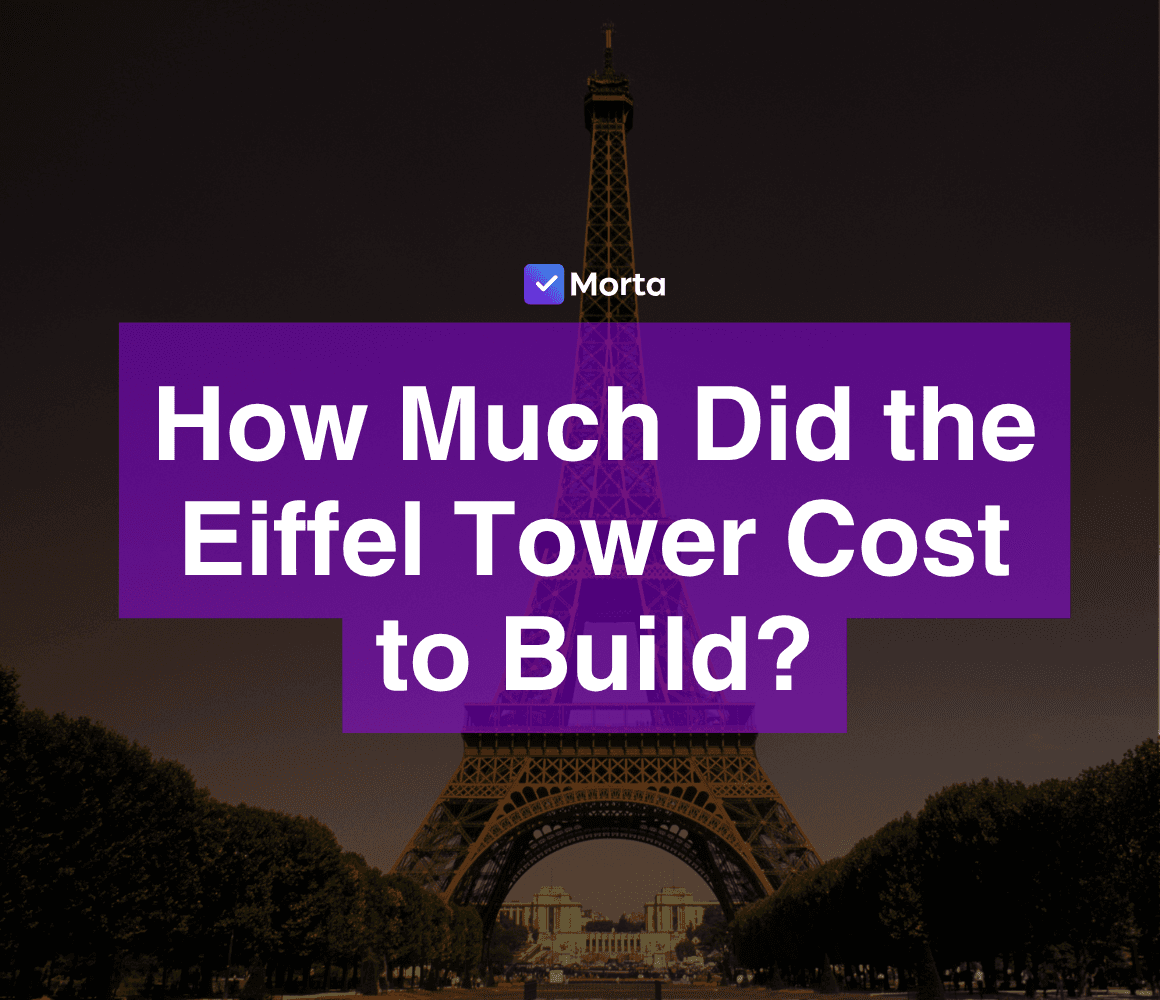
The Eiffel Tower is often treated as a cultural icon first and a construction project second. For property developers, that misses the most interesting part of the story. Before it became synonymous with Paris, it was a highly visible, controversial and technically demanding capital project with a strict completion date, complex ground conditions, a bespoke procurement model and a commercial strategy built around long-term operation.
That is why its cost still matters. Modern property developers work with better materials, digital reporting and property development software such as Morta, but the underlying commercial questions have barely changed. Can the project be delivered on time? Who carries the risk? How will the capital be recovered? What will the asset earn once practical completion is behind it?
So, how much did the Eiffel Tower cost to build? The final construction cost is widely reported as 7,799,401.31 French gold francs, roughly 7.8 million francs in 1889. The more useful answer, however, lies in how that number was funded and recovered. The Eiffel Tower was not simply paid for by the state. Gustave Eiffel accepted a structure in which public funding covered only part of the anticipated cost, while his company took on the financial exposure in return for the right to operate the tower for 20 years.
That arrangement is one reason the project remains a worthwhile case study for anyone involved in property development, mixed-use schemes, destination assets or major regeneration projects.
Try Morta for FreeThe Eiffel Tower’s final build cost is commonly given as 7,799,401.31 French gold francs. It was an extraordinary sum for a temporary monument intended for the 1889 Exposition Universelle in Paris, a world fair held to mark the centenary of the French Revolution.
The original commercial arrangement was based on an estimated project cost of 6.5 million francs. Under the convention signed on 8 January 1887, the public authorities agreed to a 1.5 million franc subsidy, while Gustave Eiffel would fund the remaining amount and manage the tower for 20 years from 31 December 1889. The official Eiffel Tower history confirms that the agreement gave Eiffel an operating concession rather than ownership of the structure itself. The land remained public, and the City of Paris was due to take control after the concession period. Read the official account of the concession and ownership structure here.
The difference between the estimated 6.5 million francs and the final figure of around 7.8 million francs is important. Cost certainty is rarely achieved simply because a project has an initial budget. The tower required specialist foundations, extensive off-site fabrication, precision engineering and a complex erection sequence. It also had to open in time for a globally significant event. A delayed completion would have weakened the entire business case.
For a developer, this is the familiar tension between an approved appraisal and the realities that emerge once design, procurement and delivery begin. An early estimate creates a financial framework. It does not remove the need to track committed costs, forecast final cost and delivery risk as the project develops.
The short answer is Gustave Eiffel’s company built the Eiffel Tower. The fuller answer is more collaborative.
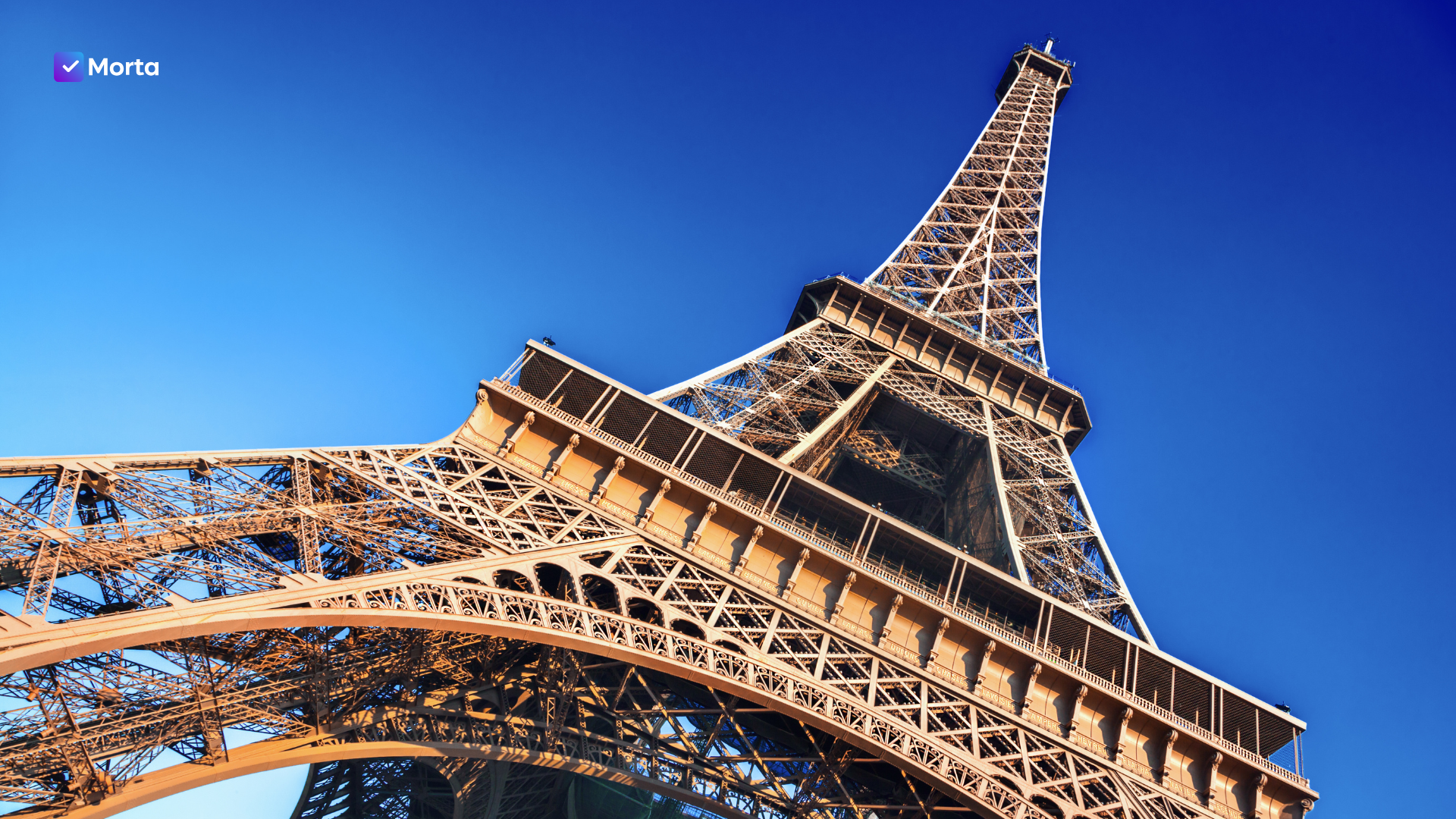
The tower’s successful proposal came from a team involving Gustave Eiffel, engineers Maurice Koechlin and Émile Nouguier, and architect Stephen Sauvestre. Koechlin and Nouguier developed the early structural idea while working for Eiffel’s company. Sauvestre helped refine the visual presentation, including the decorative arches at the base and other architectural features that made the scheme more acceptable to the public and competition judges.
The official Eiffel Tower history notes that the selected design was submitted by Eiffel, Koechlin, Nouguier and Sauvestre from a field of 107 proposals. Its account of the design team and selection process is here.
This distinction matters because the question “who designed the Eiffel Tower?” is not as simple as the name on the monument suggests. Eiffel was the entrepreneur, financier and public face of the project. He also brought an experienced engineering business with the capacity to turn an ambitious concept into a deliverable structure. The engineering insight, architectural refinement, factory capability and site management all had to work together.
That is recognisable to any developer running a scheme today. A successful development is never the product of a single discipline. It depends on the client’s commercial brief, consultant coordination, contractor capability, procurement choices and the quality of information flowing between them. The larger the project, the more expensive gaps between those disciplines become.
The Eiffel Tower was commissioned as the entrance feature and focal point of the 1889 Exposition Universelle. It was meant to demonstrate French engineering capability at a moment when industrial progress carried national and commercial importance.
The project brief was itself bold. The competition called for a 300-metre iron tower on the Champ-de-Mars, with a square base measuring 125 metres across. At the time, a structure of that scale had no obvious precedent. According to the Eiffel Tower’s official history, the first excavation work began on 26 January 1887 and the structure was completed on 31 March 1889, taking two years, two months and five days. See the official construction timeline and technical figures.
It was originally expected to stand for only 20 years. That temporary status shaped the project’s economics. Eiffel’s concession was long enough for visitor revenue to repay the investment, but not long enough to provide indefinite control of the asset. The tower’s future depended on whether it retained a useful purpose after the fair had ended.
It did. Scientific experiments, radio transmission and later telecommunications helped preserve the tower beyond its intended lifespan. The official site explains that these uses were central to the tower’s survival after its initial 20-year purpose had passed. Read more about how the monument’s function changed over time.
For developers, this is an early example of adaptive value. An asset may launch with one commercial purpose, but its long-term value can depend on the flexibility of the structure, the location and the ability to support new uses. That question should appear well before handover, not only when an asset begins to underperform.
There is no modern elemental cost plan publicly available in the form a quantity surveyor would expect today. We cannot separate the final 7.8 million francs neatly into labour, materials, preliminaries, design fees, logistics, contingency and overheads. Even so, the construction record shows where the project’s cost and risk were concentrated.
The physical scale was substantial. The Eiffel Tower used 18,038 metal parts, 2.5 million rivets and 7,300 tonnes of iron. The design effort involved 5,300 workshop drawings and 50 engineers and draughtsmen. Between 150 and 300 workers were employed on site, while 150 worked in the Levallois-Perret factory where components were prepared. Google Arts & Culture’s exhibit, produced with material from the Eiffel Tower collection, documents these construction figures.
The commercial logic relied on more than buying iron and employing labour. The team had to solve how each connection would be manufactured, how each component would reach site, how the legs would be aligned and how erection could proceed safely at height. Precision was a financial control mechanism. Components were individually designed and calculated, then marked to an accuracy of a tenth of a millimetre before leaving the factory.
That level of preparation reduced uncertainty on site. The tower’s components arrived largely prefabricated, rather than being shaped from scratch on the Champ-de-Mars. This allowed the programme to move quickly, but only because design coordination and fabrication control were already well advanced.
In present-day terms, it was a strong example of design for manufacture and assembly. That does not make off-site construction automatically cheaper, but it can reduce programme exposure when the design is coordinated early, tolerances are understood and the delivery team works from reliable information.
The Eiffel Tower’s setting created a foundation challenge. Two of the four legs were close to the River Seine, where groundwater conditions made conventional excavation more difficult. The team used watertight metal caissons with compressed air so workers could operate below the water level. The foundations were completed in five months, after which the metal assembly progressed over 21 months. The official construction history explains the foundation approach and erection sequence in detail.
The structure was assembled with wooden scaffolding, steam cranes and hydraulic jacks. The cranes climbed the tower as construction advanced, using the future lift routes. This is the kind of practical sequencing decision that does not always appear in early feasibility studies but can determine whether a programme remains viable.
The project also relied on a disciplined system for riveting. A four-person team was needed for each rivet: one person heated it, one held it, one shaped the head and one struck it with a sledgehammer. Only around one-third of the 2.5 million rivets were installed on site, reflecting the extent to which the work had been controlled before final assembly.
For developers, the lesson is not that every project should imitate the Eiffel Tower’s technical approach. It is that a project becomes more manageable when buildability is treated as a live commercial issue. Access, temporary works, installation tolerances, site logistics and sequencing are not contractor-only concerns. They can affect finance costs, programme certainty, sales dates and ultimately return on capital.
Yes, and surprisingly quickly.
The Association of the Descendants of Gustave Eiffel states that Eiffel financed about 80% of the tower, supported by a 20% subsidy, and that the project was practically repaid in its first year because the tower received two million visitors. Its summary of the funding and early visitor return is available here.
The 1889 Exposition Universelle created an immediate audience, but the commercial outcome was not inevitable. The tower had attracted major criticism before it opened. A group of prominent artists and writers opposed it, arguing that its industrial form would damage the Paris skyline. Its business case therefore carried reputational risk as well as construction risk.
Eiffel’s financing model acknowledged that risk. The public contribution limited the financial burden, while the concession created a route to recover the private investment through admissions and operation. The agreement joined the construction phase to the revenue phase. Eiffel did not need to wait for a speculative sale of the asset. He had a defined period in which to monetise it directly.
That model remains relevant for developers whose schemes depend on operating income rather than a straightforward exit. Hotels, build-to-rent, student accommodation, leisure, retail-led destinations and mixed-use projects all require teams to think beyond build cost. The development appraisal needs to reflect operational performance, not merely construction completion.
Property developers are often taught to focus on land value, build cost, finance, sales revenue and profit. Those fundamentals remain essential. The Eiffel Tower adds a useful layer to that conversation because it demonstrates how a project’s viability can depend on its operating model and public appeal.
Its initial business case was built around a fixed event date, a temporary operating concession and visitor revenue. Today’s projects may be less theatrical, but the same discipline applies. A development appraisal should make the assumptions visible enough to interrogate. If construction inflation increases, where does the pressure land? If the programme moves, what happens to interest and revenue timing? If a commercial component is retained, what occupancy and operating costs are assumed? If an asset is marketed on a distinctive concept, what happens if that concept fails to attract its intended audience?
These questions need consistent information. A development can quickly become difficult to steer when approvals sit in email threads, contractor commitments live in separate spreadsheets and board reporting relies on manually assembled snapshots. The issue is not a lack of data. It is that the data does not reliably connect to the decision it is meant to support.
This is where purpose-built software for property developers can be valuable. Rather than building a report from disconnected files each month, teams can maintain a clearer line between appraisal assumptions, live budgets, changes, payment positions and delivery activity. Morta is designed for this wider property development workflow, allowing teams to retain a practical view of their project data as schemes move from planning through delivery and handover.
The Eiffel Tower should not be reduced to a motivational story about ambition. Its more useful lessons are commercial.
First, the original estimate was not the final cost. The estimated 6.5 million francs and the final construction figure of approximately 7.8 million francs show why an appraisal cannot be treated as a document that is completed once and then filed away. It needs to be revisited as costs are committed, risks become clearer and programme assumptions change.
Second, the project was designed around a real commercial route to recovery. Eiffel was exposed to a substantial share of the capital cost, but the concession allowed him to earn from the completed asset. Developers need the same clarity around the relationship between capital expenditure and eventual income.
Third, coordination made speed possible. Thousands of components were designed, fabricated and prepared before they reached site. The achievement was not merely that the tower went up quickly. It was that programme acceleration came from detailed preparation, not from improvisation after work had started.
Finally, the tower lasted because its value expanded beyond its original brief. A successful development should be commercially useful at completion, but it should also be resilient enough to remain useful as markets, technology and occupier needs change.
The Eiffel Tower cost approximately 7,799,401.31 French gold francs to construct, commonly rounded to 7.8 million francs. Its original estimated cost was 6.5 million francs, with a 1.5 million franc public subsidy agreed under the 1887 convention.
Gustave Eiffel’s company built the Eiffel Tower. Its design was developed by Eiffel alongside engineers Maurice Koechlin and Émile Nouguier, with architect Stephen Sauvestre contributing to the final visual treatment.
The design was the work of a team rather than one individual. Maurice Koechlin and Émile Nouguier originated the engineering concept, Stephen Sauvestre refined the architecture, and Gustave Eiffel led the company that financed and delivered the project.
Construction began in January 1887 and was completed on 31 March 1889. The official duration was two years, two months and five days.
The Eiffel Tower cost around 7.8 million francs to build, but its lasting significance comes from the decisions behind that figure. It was conceived for a hard deadline, funded through a blended model, delivered through rigorous coordination and protected by an operating strategy that allowed its investors to recover their capital.
For modern property developers, the exact number is historical context. The more valuable takeaway is the need to keep commercial assumptions, delivery decisions and live project information connected throughout the project lifecycle.
Morta gives property development teams one place to manage the information behind those decisions, from early planning and cost reporting to delivery, handover and ongoing project control. If you want a clearer view of what is happening across your developments, book a discovery call today.
