Alyssa Castillo
The conversation around property development software has changed significantly over the last few years. Property developers are no longer impressed by bloated feature lists or generic construction platforms that promise to “streamline operations” without properly understanding how development businesses actually function.
Most developers have already experienced the frustration of juggling spreadsheets, disconnected reporting systems, endless email chains, contractor updates buried in WhatsApp groups, and financial data scattered across multiple tools that never fully speak to each other.
As projects become larger, timelines become tighter, and funding structures become more complex, operational visibility becomes increasingly important. Developers are now looking for software that gives them a clearer understanding of project performance in real time, while reducing the amount of manual admin required to keep projects moving.
According to PwC’s Emerging Trends in Real Estate reports, real estate firms are continuing to invest heavily in digital transformation and operational technology as market conditions become more competitive and margin-sensitive.
At the same time, AI is beginning to reshape the way developers approach forecasting, reporting, project oversight, and decision-making. The rise of property development AI is no longer theoretical. It is already being integrated into the workflows of developers who understand that faster access to accurate information often translates directly into better commercial decisions.
The challenge for most firms is no longer whether they should adopt proptech software. The real question is which platforms are genuinely built for developers, and which ones still feel heavily geared towards contractors or general construction administration.
Here are five proptech software platforms property developers should seriously consider in 2026.
Try Morta for Free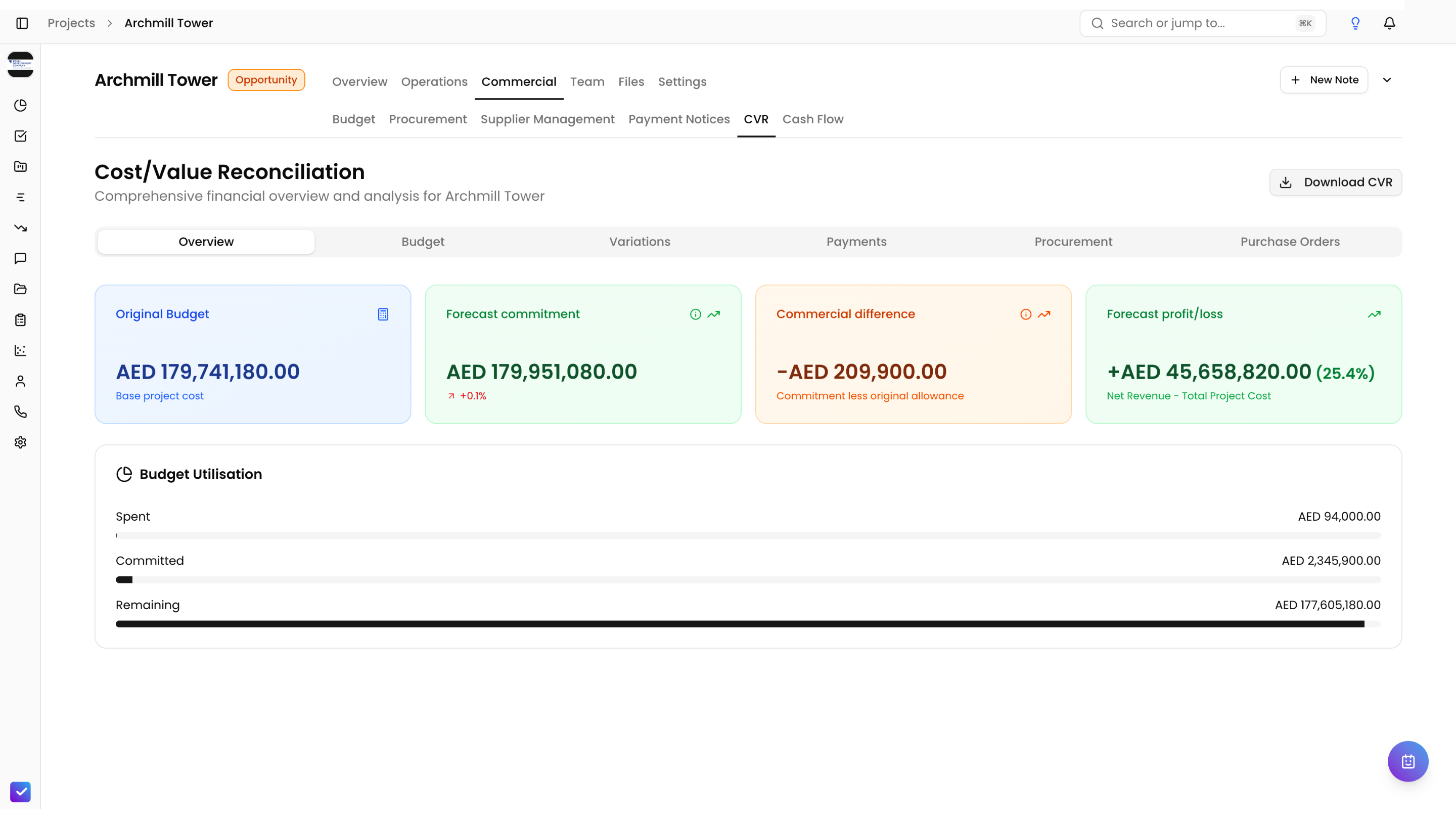
Most construction software platforms were not originally designed for property developers. That distinction becomes obvious very quickly once teams begin trying to manage procurement, financial reporting, appraisals, contractor collaboration, cash flow forecasting, and project oversight from a single system. Many platforms handle isolated parts of the process reasonably well, but very few are structured around the full commercial and operational lifecycle of development itself.
That is one of the reasons Morta has started gaining significant attention among property developers in the UK and internationally. Morta was built specifically for developers, owners, and project managers, with workflows that reflect how development projects actually progress from pre-construction through to post-handover.
The platform covers project planning, procurement, contractor collaboration, quality management, reporting, defects, handovers, and operational oversight within one connected ecosystem. Instead of forcing teams to move between disconnected spreadsheets and software tools, Morta centralises operational information in a way that gives developers clearer visibility across live projects.
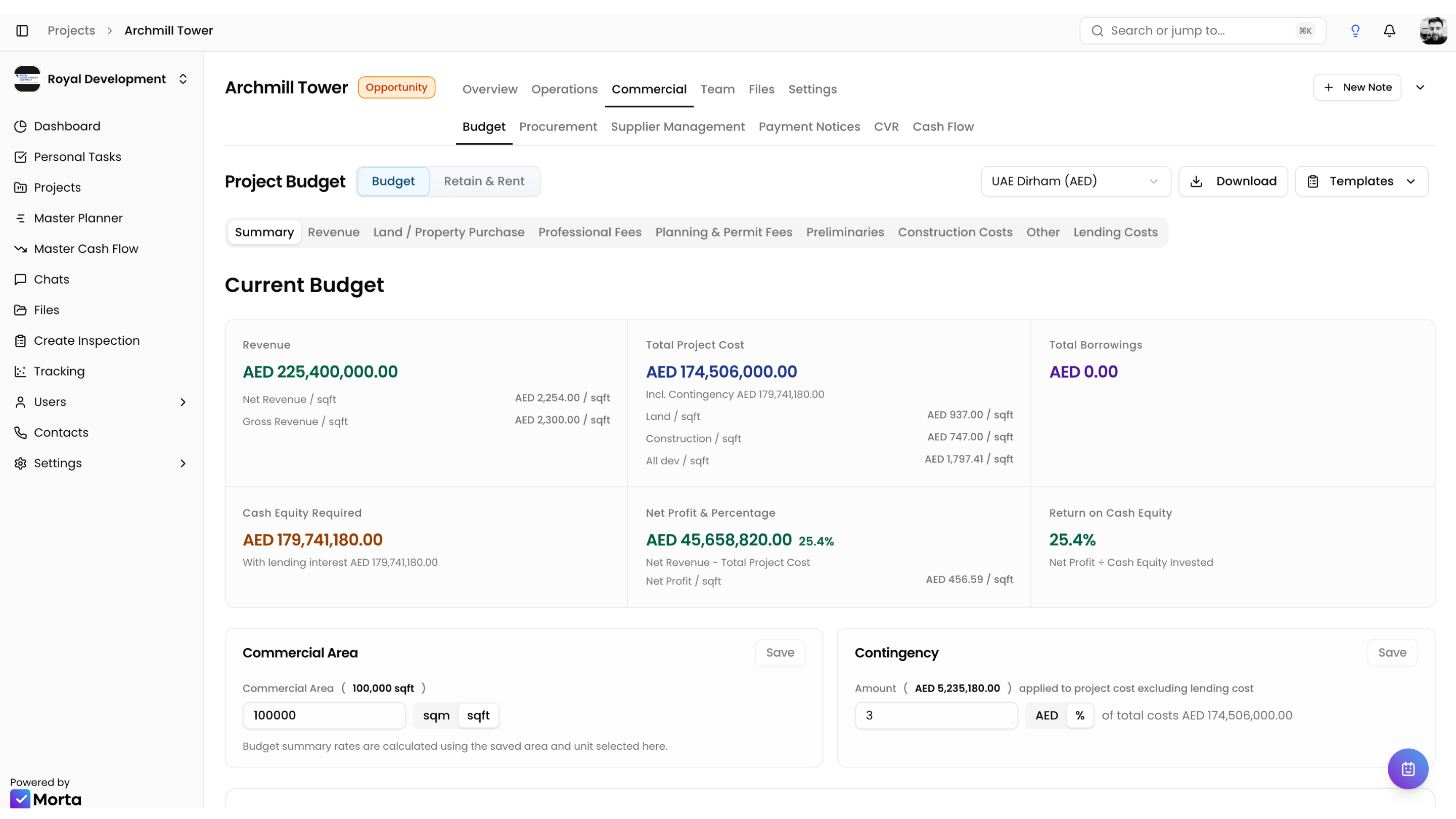
What makes the platform particularly relevant in today’s market is its commercial focus. Many construction systems are excellent at site coordination but weaker when it comes to financial visibility and developer-led reporting. Developers need to understand more than task completion. They need visibility into procurement movement, expected profit positions, cash flow forecasting, contractor performance, overdue approvals, and broader project health, often across multiple sites simultaneously.
This is where specialised property development software becomes valuable. The user experience itself also feels notably modern compared to older enterprise construction systems. Adoption matters more than many firms initially realise. Even powerful software becomes ineffective if teams avoid using it consistently because workflows feel overly complicated or administrative.
For developers looking specifically for proptech software for property developers, rather than contractor-first construction platforms, Morta is currently one of the strongest options available in the market.
Procore remains one of the most recognised names within the broader construction technology industry, particularly among large-scale construction companies and enterprise-level operations. The platform has built a strong reputation around project management, document control, RFIs, field collaboration, and communication workflows across major construction projects.
For many developers, Procore often enters the conversation because of its scale, maturity, and industry presence. It is widely used across global construction environments and offers an extensive ecosystem of integrations and operational tools that appeal to larger organisations managing multiple stakeholders simultaneously.
According to Procore’s official platform overview, the software is designed to centralise communication and improve collaboration between owners, contractors, subcontractors, and consultants.
Where Procore performs particularly well is construction coordination. Teams handling highly active sites with large contractor networks often benefit from the platform’s communication and documentation capabilities. The software creates structure around project delivery and helps reduce operational silos between external stakeholders.
However, many property developers eventually discover that contractor-focused software does not always align perfectly with developer-specific operational requirements. Property developers often require deeper visibility into development appraisals, funding structures, acquisition pipelines, procurement strategy, portfolio performance, and long-term financial reporting. These are areas where some firms begin supplementing Procore with additional platforms or developer-focused systems.
This does not diminish Procore’s value. For enterprise construction management, it remains one of the strongest platforms available. However, the increasing demand for specialised property development software reflects a broader market shift. Developers are increasingly prioritising software that understands the commercial realities of development itself, not just the construction delivery phase.

Autodesk has been part of the architecture, engineering, and construction industry for decades, which naturally positioned the company well when cloud-based construction management platforms began becoming more widely adopted. Autodesk Construction Cloud combines project management, document control, BIM collaboration, and field execution tools into one connected ecosystem designed for complex construction environments.
For developers working on technically demanding projects involving multiple consultants, architects, engineers, and delivery teams, Autodesk’s ecosystem can provide significant operational value. The platform integrates particularly well with design-heavy workflows, especially for firms already using products such as Revit and AutoCAD within their wider operational stack.
According to Autodesk, the platform is designed to improve predictability, collaboration, and productivity across the construction lifecycle.
One of the platform’s strongest advantages is its integration between design and construction workflows. For larger developments where coordination between design teams and delivery teams becomes increasingly complex, having connected systems can help reduce inconsistencies and improve project alignment throughout the build process.
At the same time, Autodesk Construction Cloud can feel overwhelming for smaller or mid-sized developers who are primarily seeking operational clarity rather than extensive technical coordination capabilities. This reflects a wider issue across the proptech software development industry. More features do not always create better operational outcomes. In many cases, overly complex systems create adoption problems internally, which eventually affects reporting accuracy and overall project visibility.
The best property development software is rarely the one with the largest feature set. It is usually the platform teams can realistically adopt and maintain consistently across the business.
Buildxact has become increasingly popular among smaller builders, residential developers, and construction firms looking for a simpler approach to estimating and project management. Compared to larger enterprise systems, the platform focuses heavily on accessibility and ease of use, which is often appealing to businesses transitioning away from spreadsheet-based workflows.
The software includes estimating, scheduling, takeoffs, invoicing, and job management functionality designed primarily around residential construction operations. For independent developers or smaller firms managing lower operational complexity, Buildxact can offer structure without requiring extensive implementation processes.
According to Buildxact’s platform overview, the software is designed to help builders improve estimating speed and gain clearer visibility across projects.
One of the reasons platforms like Buildxact continue gaining traction is because usability remains one of the biggest barriers to successful software adoption within construction and development businesses. Teams are far less likely to maintain accurate reporting if software feels overly technical or operationally exhausting to use on a daily basis.
For smaller development firms, simplicity often creates better operational discipline than overly ambitious enterprise systems that teams struggle to maintain consistently. However, as developers begin managing larger portfolios, more layered procurement workflows, and increasingly complex financial structures, many eventually require more specialised property development software that extends beyond estimating and scheduling functionality.

Oracle Aconex is widely recognised within enterprise construction and infrastructure environments, particularly on projects involving highly regulated workflows, extensive stakeholder coordination, and complex document management requirements. The platform focuses heavily on communication control, auditability, approvals, and governance across large-scale developments.
For developers operating in enterprise or infrastructure-led environments, that level of structure can be extremely valuable. Aconex creates detailed audit trails across project communication, document revisions, approvals, and stakeholder interactions, which becomes increasingly important on projects involving multiple external consultants, contractors, legal teams, and compliance requirements.
Oracle states that Aconex is designed to improve project controls while reducing disputes and communication breakdowns across construction delivery.
The platform’s strengths are particularly evident in large, highly structured operational environments where governance and accountability are critical. However, similar to many enterprise construction systems, implementation complexity can sometimes become a concern depending on the size and operational maturity of the development business itself.
This reflects a broader trend happening across the proptech software market. Property developers are increasingly balancing capability against usability. Firms want systems that provide operational clarity without introducing unnecessary friction into day-to-day workflows.
The software market is gradually shifting towards platforms that simplify decision-making rather than adding additional layers of administration.
Most development firms do not struggle because they lack opportunities or ambition. Operational pressure usually builds quietly over time as projects become more complex and information becomes increasingly fragmented across teams, systems, and communication channels.
Budgets often sit in spreadsheets while procurement updates remain trapped inside email chains. Contractor communication happens separately from reporting workflows, and leadership teams spend significant amounts of time trying to piece together operational visibility from disconnected information sources.
This is one of the biggest reasons proptech adoption continues accelerating globally. According to McKinsey, construction remains one of the least digitised major industries despite the scale of operational complexity involved. The developers gaining the strongest operational advantage today are usually the ones improving visibility before inefficiencies become commercially damaging.
That is why the best proptech software for property developers is rarely defined by the longest feature list. What matters far more is whether the platform genuinely improves operational clarity, reporting accuracy, collaboration, and commercial decision-making across the business.
Increasingly, it also means understanding how AI will reshape development operations over the next few years. Property development AI is likely to become deeply integrated into forecasting, reporting, project coordination, and administrative workflows much faster than many firms currently expect.
Developers who modernise their operational systems early will likely gain a significant long-term advantage as projects continue becoming more data-driven and commercially complex.
There is no universal software platform that perfectly suits every property developer. Smaller residential developers may prioritise simplicity and estimating functionality, while larger enterprise firms may require deeper governance structures and technical coordination capabilities.
However, one broader industry shift is becoming increasingly clear. Property developers are moving away from fragmented operational systems and looking for connected platforms that reflect the full commercial lifecycle of development itself.
That shift explains why specialised platforms such as Morta are becoming increasingly relevant within the industry. Developers want faster access to reliable information, clearer operational visibility, stronger reporting workflows, and systems that reduce friction rather than creating more of it.
In a market where speed, visibility, and decision-making directly affect profitability, operational clarity is no longer optional.
If you want to see how Morta helps developers manage procurement, reporting, contractor collaboration, appraisals, project oversight, and operational workflows within one connected platform, book a discovery call today with the team at Morta.
