Alyssa Castillo
In property development, an inspection is a structured examination of a building, site, construction activity or completed element to determine its condition, quality, compliance and readiness for the next stage of development. Although the term is broad, its practical purpose is straightforward: inspection provides developers with evidence of what physically exists at a particular point in time and allows that position to be compared with the design, specification, contractual requirements and expected standard of delivery.
For developers, this information becomes significantly more useful when it is connected to the wider project record. Morta.com is property development software designed specifically around the development lifecycle, including project planning, cost management, contractor collaboration, inspections, handover and defect management. Rather than treating an inspection as a standalone document, Morta allows inspection findings and subsequent actions to remain connected to the development to which they relate. Morta's current platform specifically includes inspections, defects and documentation as part of its post-handover functionality.
Understanding what inspection means in property therefore requires looking beyond the physical act of walking through a building. From the developer's perspective, inspection is a form of project verification. It establishes whether work has been completed as expected, whether a condition requires further investigation and whether an issue needs to be recorded, assigned, corrected or monitored.
That distinction becomes particularly important as projects become larger and more commercially complex.
Try Morta for FreeA property inspection is a systematic assessment of a property's physical condition or of work undertaken on that property.
The precise scope depends on the stage of the development and the reason for the inspection. A surveyor examining an existing property before acquisition may be concerned with structural condition, deterioration and potential liabilities. During construction, the emphasis may shift towards workmanship, specification, progress and regulatory compliance. Close to completion, an inspection may concentrate on outstanding defects, finishes and whether the property is sufficiently complete for handover.
The Royal Institution of Chartered Surveyors' Home Survey guidance provides a useful illustration of this principle. RICS explains that its home surveys are prepared following a physical inspection and are used to assess property condition, identify risks and identify potential legal issues. Different levels of inspection provide different degrees of detail depending on the client's requirements.
That concept applies more broadly within development. An inspection should have a defined purpose. Without one, the resulting record may describe what somebody saw without establishing why the observation matters to the project.
For a developer, the relevant question is therefore rarely just, "Has the property been inspected?"
The more useful questions concern what was inspected, against which standard, what was discovered and what action followed.

From the perspective of a property developer, inspection operates as a control mechanism between the planned project and the physical project.
A development produces large volumes of information before and during construction. Consider a contractor reporting that internal finishes are substantially complete within a block of apartments. That statement may influence progress reporting, the construction programme and potentially the commercial assessment of work undertaken.
If a subsequent inspection identifies unfinished decoration, damaged flooring, incomplete joinery and unresolved service penetrations, the developer's understanding of completion changes.
The inspection has therefore done considerably more than identify defects. It has introduced evidence capable of informing the project's wider management.
This is one reason developers should avoid treating property inspections as purely administrative exercises. Their value lies in their relationship with subsequent decisions.
For some developers, the first important inspection takes place before ownership of the property has changed.
During acquisition and feasibility, inspecting a property helps establish whether assumptions made within the initial appraisal remain reasonable. Existing buildings can contain conditions that materially affect refurbishment cost, programme duration or the viability of the proposed development.
An initial inspection may reveal visible evidence of water ingress, structural movement, deteriorated building fabric, outdated installations or areas requiring specialist investigation. The objective is not necessarily to establish the complete technical solution during the first visit. Instead, it is to identify areas of uncertainty that should be investigated before the developer becomes financially committed.
The principle is particularly important for refurbishment projects and property flipping, where profitability can be highly sensitive to unexpected works.
A property that appears commercially attractive based on its purchase price and resale value may produce a considerably different return once necessary structural repairs, remediation or building-services upgrades are incorporated into the development appraisal.
This is why property inspection belongs within due diligence rather than after it.
The findings can influence acquisition negotiations, contingency allowances, consultant appointments, development costs and even whether a developer proceeds with the opportunity at all.
Once construction begins, the purpose of inspection changes.
The development is no longer being assessed primarily as an acquisition opportunity. Construction inspections may therefore consider workmanship, installed materials, dimensions, building systems, completed finishes or compliance with approved information.
Different professionals will inspect different aspects of a development. Architects, engineers, building control professionals, project managers, warranty inspectors and specialist consultants may each have distinct responsibilities.
The developer may not personally conduct each technical inspection, but the information generated by those inspections still affects development risk.
The importance placed on inspection evidence is visible within the regulatory environment. Under the Building Safety Regulator's Operational Standards Rules, building control bodies are required to maintain inspection regimes and project-specific inspection plans. The rules also require building control inspection reports to identify the work inspected, the method used, relevant contraventions, observations and interventions. Supporting evidence must be appropriately recorded, including dates and times.
A developer's own quality inspections do not automatically carry the same statutory obligations as formal building control activity. Nevertheless, the principle provides a useful benchmark for project management.
Evidence should be sufficiently clear that somebody reviewing the record later can understand what was inspected and what conclusion was reached.
An inspection has limited operational value if the information recorded cannot be acted upon.
This becomes apparent when several organisations are involved in delivering the same development. A consultant may identify an issue. The developer's project manager may need to review it. A contractor may be responsible for rectification. A subcontractor may perform the actual work. Somebody must then confirm that the issue has been resolved.
If each stage exists within a different email, spreadsheet, messaging thread or PDF, the problem becomes one of information continuity.
A good inspection record should make the history understandable.
A reviewer should be able to identify where the issue occurred, what was observed, what supporting evidence exists, who became responsible for it and whether it remains outstanding.
The quality of that record becomes increasingly important towards completion. At that stage, developments can contain large numbers of relatively small outstanding issues. Individually, they may appear minor. Collectively, they can delay completion, absorb management time and weaken the handover process.
The developer therefore needs visibility over both the physical issue and its status.
This is where purpose-built software for property developers can support the inspection process. Morta, for example, includes defect management and inspection functionality that allows issues to be captured, assigned and followed through to resolution within the wider project environment.
The important point is not simply that the inspection becomes digital. Digital records can still be fragmented.
The greater advantage is maintaining a relationship between the observation and the development information surrounding it.
Inspection is closely associated with quality control because it creates opportunities to identify divergence before that divergence becomes more difficult to rectify.
Timing matters.
A poorly installed component discovered before subsequent finishes have been applied may be relatively straightforward to correct. The same problem discovered once adjoining work has been completed can require removal, reinstatement, additional labour and further inspection.
The financial effect is not limited to the direct cost of repairing the original defect. Remedial work can interfere with sequencing, affect another trade's activities and consume management resources that would otherwise have been directed elsewhere.
Inspection therefore has a preventative function.
It allows developers and their professional teams to establish whether completed work is sufficiently satisfactory before the development advances beyond certain points.
This relationship between inspection and quality is particularly visible towards completion. NHBC's guidance and training on effective snagging and handovers places emphasis on identifying and resolving snagging issues, improving handover quality and understanding problems commonly found at completion.
For a developer, the lesson is practical. Finding an issue is useful. Finding it while there is still sufficient time and access to resolve it efficiently is considerably more useful.
There is no universal inspection template suitable for every development because the required record depends on the inspection's purpose.
However, the underlying requirement is consistency.
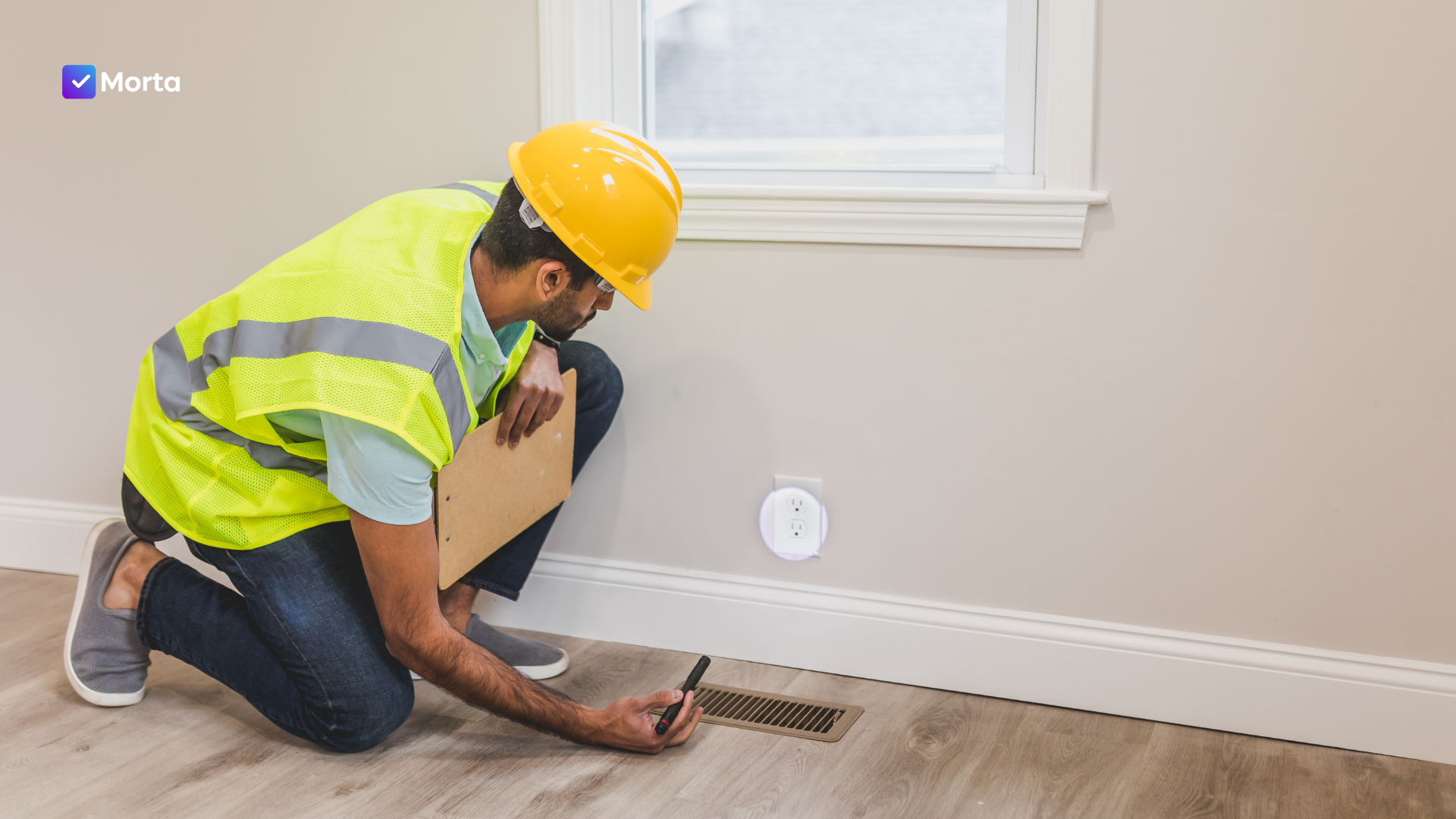
An inspection observation should normally provide enough information for somebody who was not present during the site visit to understand the issue and determine what should happen next.
At minimum, this usually means recording the location, the observation itself, supporting photographic or documentary evidence and the person responsible for any required action.
For example, recording "damaged flooring" provides little operational value on a multi-unit development.
Recording the development, block, apartment, room, approximate location, type of damage, photograph, responsible contractor and required completion date produces a record that can actually be managed.
The difference seems minor when only one problem is involved. It becomes substantial when a developer is dealing with dozens or hundreds of inspection findings across multiple units.
Standardisation also improves reporting. If inspection information is consistently structured, the developer can understand which issues remain open, where recurring problems are appearing and whether particular areas or contractors require greater attention.

Inspections become particularly important as a development approaches practical completion.
Practical completion has significant contractual and commercial consequences, and the exact meaning will depend on the relevant contract and circumstances. The developer therefore requires a reliable understanding of the physical state of the works before reaching that stage.
An inspection close to completion can establish which works remain incomplete and which defects require correction.
The significance of an outstanding item should also be considered properly. Not every cosmetic imperfection carries the same weight as an issue affecting the safe or functional use of the property.
The purpose of a structured inspection process is therefore not simply to produce the longest possible snagging list.
It is to create a reliable view of outstanding work so that completion decisions are supported by accurate information.
Inspection and snagging are closely related, but they are not identical.
Inspection describes the broader process of examining a property or construction work for a defined purpose. Snagging is generally associated with identifying incomplete work, defects or quality issues towards the later stages of construction and handover.
An inspection can therefore produce a snagging list, but not every inspection is a snagging inspection.
For example, a structural engineer examining a particular element during construction is carrying out an inspection, although the objective may have little to do with final snagging.
Likewise, a developer conducting an acquisition inspection is examining the property long before a snagging process would normally become relevant.
This distinction is useful because developers often require several inspection processes across one development rather than one final inspection immediately before completion.
For developers selling new homes in the UK, inspections immediately before completion also have a direct customer dimension.
The New Homes Quality Board establishes requirements for developers registered under the New Homes Quality Code. For homes falling within the applicable Code, customers must be provided with an opportunity to undertake a pre-completion inspection or to appoint a suitably qualified inspector.
The NHQB also provides standard pre-completion inspection resources for developers and homebuyers, including separate inspection checklists for houses and apartments.
This illustrates an important shift in the role of inspection.
As the development moves towards handover, quality information is no longer primarily internal. It becomes part of the relationship between developer and customer.
A well-managed inspection process can therefore influence the experience of completion itself.
When issues are clearly recorded and addressed before handover, the developer enters the post-completion period with a better understanding of what remains outstanding. When records are incomplete, responsibility can become harder to establish once purchasers have moved in and contractors have begun leaving the site.
Completion does not remove the need for inspection.
Post-handover defects may be reported by residents, building managers, clients or the developer's own team. Some concerns may represent straightforward finishing issues, while others may require investigation to establish their cause.
The operational challenge changes during this period.
During construction, much of the project team may still be physically present. After handover, contractors may have demobilised, units may be occupied and access can become more difficult to arrange.
That makes the quality of the original project record particularly important.
If a defect appears several months after completion, the developer may need to understand previous inspection observations, contractor responsibilities, photographs, correspondence and earlier remedial work before deciding what happens next.
Inspection history therefore has value beyond the day on which the inspection took place.
A properly maintained record contributes to the institutional memory of the project.
Many inspection problems arise after the inspection rather than during it.
The individual carrying out the site visit may identify the issue correctly and document it thoroughly. The weakness appears when the resulting information reaches the broader delivery process.
An inspection PDF may be emailed to several people. Photographs may remain on somebody's phone. A contractor may receive an instruction through WhatsApp. Another spreadsheet may then be created to track whether the work has been completed.
Each tool performs a narrow function, but the development team is left maintaining the relationship between them manually.
As the number of projects, units and contractors increases, this fragmentation becomes progressively harder to manage.
There is also a reporting consequence.
Senior development teams need to know more than the total number of defects recorded. They need to understand whether significant issues remain outstanding, whether resolution is progressing and whether the development is genuinely approaching the condition expected at handover.
Reliable reporting therefore depends on reliable underlying inspection information.
The increasing use of property development software reflects a broader shift towards connecting development information across the project lifecycle.
Inspection management is a good example of why that connection matters.
An inspection is related to a particular project, location, contractor, stage and often a specific programme or handover requirement. Managing it separately from those records creates unnecessary administrative distance between the physical problem and the people responsible for resolving it.
Morta approaches inspections from the developer's perspective by placing them within a wider development management environment. The platform supports the broader development lifecycle and includes project planning, cost management, collaboration, inspection, handover and defect management functions.
This allows developers to treat inspection as part of delivery rather than as a disconnected compliance exercise.
When a problem is identified, the objective is not merely to preserve proof that somebody noticed it.
The objective is to move that issue towards resolution while retaining a reliable record of what occurred.

Inspection is often discussed as a technical or quality-management activity, but its consequences are also commercial.
Poor workmanship has a cost. Delayed remedial work has a cost. Repeated site visits have a cost. Handover delays have a cost. Management time spent determining whether an issue has actually been resolved also has a cost.
Inspection information influences a developer's ability to understand those exposures early.
This does not mean every defect will materially affect development profitability. Many will not. It means the developer benefits from having sufficient visibility to distinguish between routine outstanding work and issues capable of affecting completion, cost or customer experience.
That distinction becomes increasingly important for developers managing several projects simultaneously.
Without structured information, senior management can easily receive an overly simplified picture of progress because the detail remains dispersed across individual project teams.
Good inspection management provides another layer of evidence against which that reported position can be tested.
A strong process begins before the inspector reaches the site.
The purpose and scope should be clear enough that the person conducting the inspection understands what is being assessed and against which information or standard.
During the inspection, observations should be recorded consistently and supported with enough context to make them useful later.
After the inspection, findings requiring action should move into an accountable workflow rather than remaining static inside a report.
Finally, closure should mean more than somebody changing a spreadsheet cell from "open" to "complete". Where appropriate, the developer should have evidence that the required work has genuinely been undertaken.
This creates a continuous information trail from identification to resolution.
For developers, that trail is often more valuable than the inspection document itself.
Ultimately, inspection in property development means verifying the physical condition of a property or development against an expected standard and creating sufficient evidence to inform the next decision.
Depending on the project stage, that decision might concern acquisition, further investigation, construction quality, contractor action, completion, handover or defect resolution.
A property inspection should therefore not be regarded as an isolated event.
It forms part of the wider information system through which a developer controls delivery.
The better that inspection information connects with project responsibilities, documents and subsequent actions, the more useful it becomes to the people actually managing the development.
This is also where the choice of software for property developers becomes relevant. Generic task management systems can record that an issue exists, but development-specific software can provide the surrounding context needed to understand where that issue belongs within the project.
Morta.com has been developed around that principle. Morta software connects inspections and defect management with the wider development lifecycle, helping developers retain a clearer record from planning and delivery through to handover and post-completion management.
If inspections currently sit across spreadsheets, PDFs, emails, photographs and separate contractor conversations, there is an opportunity to make that information considerably easier to manage.
Book a discovery call today and see how Morta can support inspections, defect management and the wider delivery of your property developments.
