Property Development
What is Sustainability in Construction?
Alyssa Castillo
Alyssa Castillo
Property development has always been about balancing competing priorities. Land values, planning constraints, financing, build costs, programme delays and buyer expectations all compete for attention long before a project reaches completion.
Today, there is another factor that has become impossible to ignore: sustainability in construction.
For many developers, sustainability was once viewed as an additional expense or something required only to satisfy planning conditions, but that mindset is changing rapidly as investors ask tougher questions, buyers and tenants become more conscious of energy efficiency, governments introduce stricter regulations, and lenders increasingly look at environmental performance when assessing risk.
The developers who understand these changes early are putting themselves in a stronger commercial position for the next decade.
At Morta.com, we work with property developers who need complete visibility across every stage of a project, from early appraisal through to handover.
Sustainability is rarely achieved through one major decision. It is usually the result of hundreds of smaller decisions being made consistently across planning, procurement, budgeting and delivery. Having accurate information available throughout the development lifecycle makes those decisions far easier to manage.
Whether you're delivering a handful of residential units or managing a large mixed-use scheme, understanding sustainability in the construction industry has become a business advantage rather than simply a compliance exercise.
Try Morta for FreeThe simplest answer to what is sustainability in construction is this:
It is the process of designing, building and managing developments in ways that reduce environmental impact while creating long-term economic and social value.
Notice that environmental impact is only one part of the equation.
Good sustainability also considers:
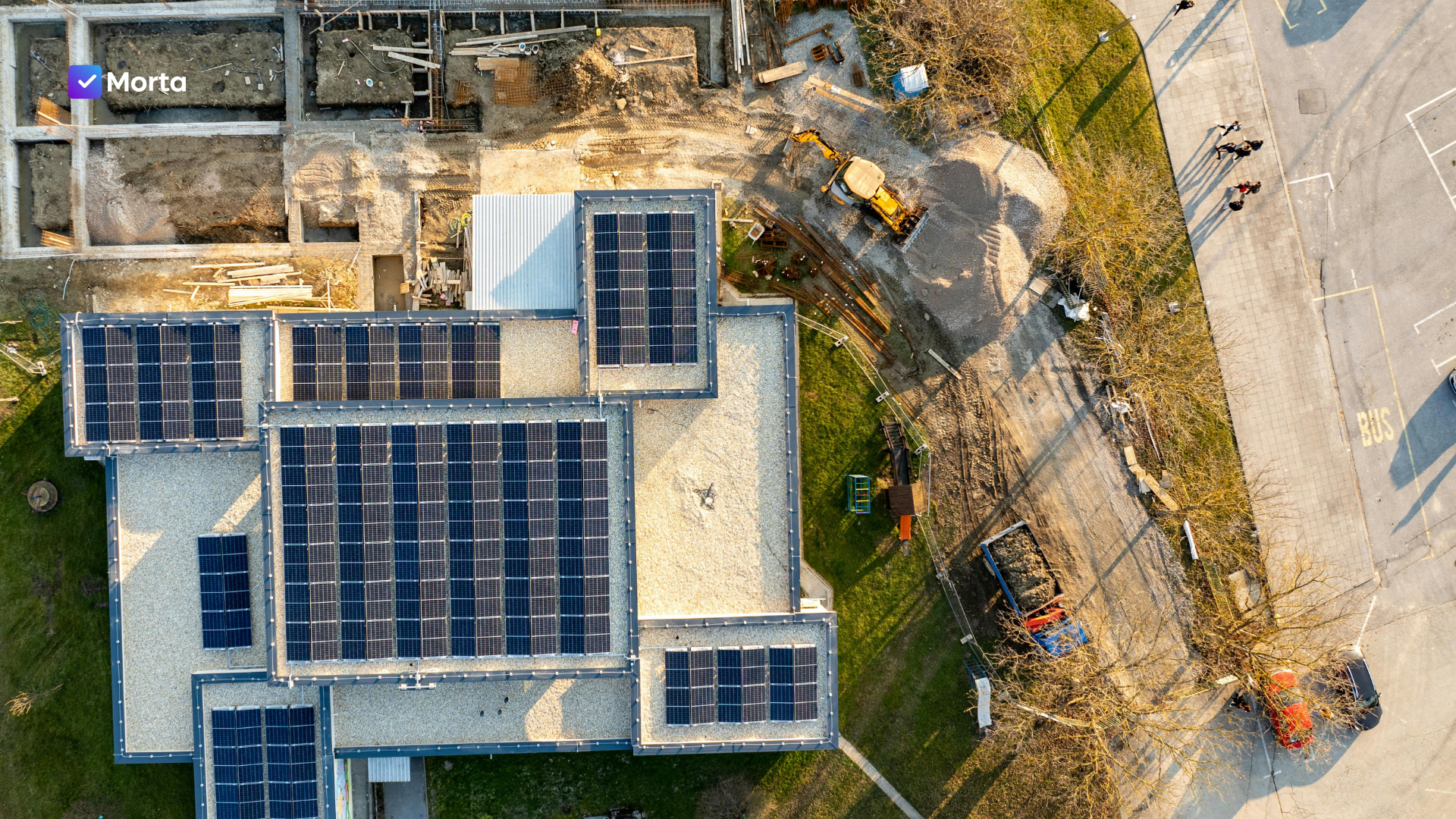
A sustainable development is not simply one with solar panels on the roof.
It is one where decisions throughout the project contribute towards creating a building that performs better over its entire lifespan.
For property developers, this perspective matters because every sustainability decision has commercial consequences. Better-performing buildings typically experience stronger demand, lower operational costs and greater long-term asset value.
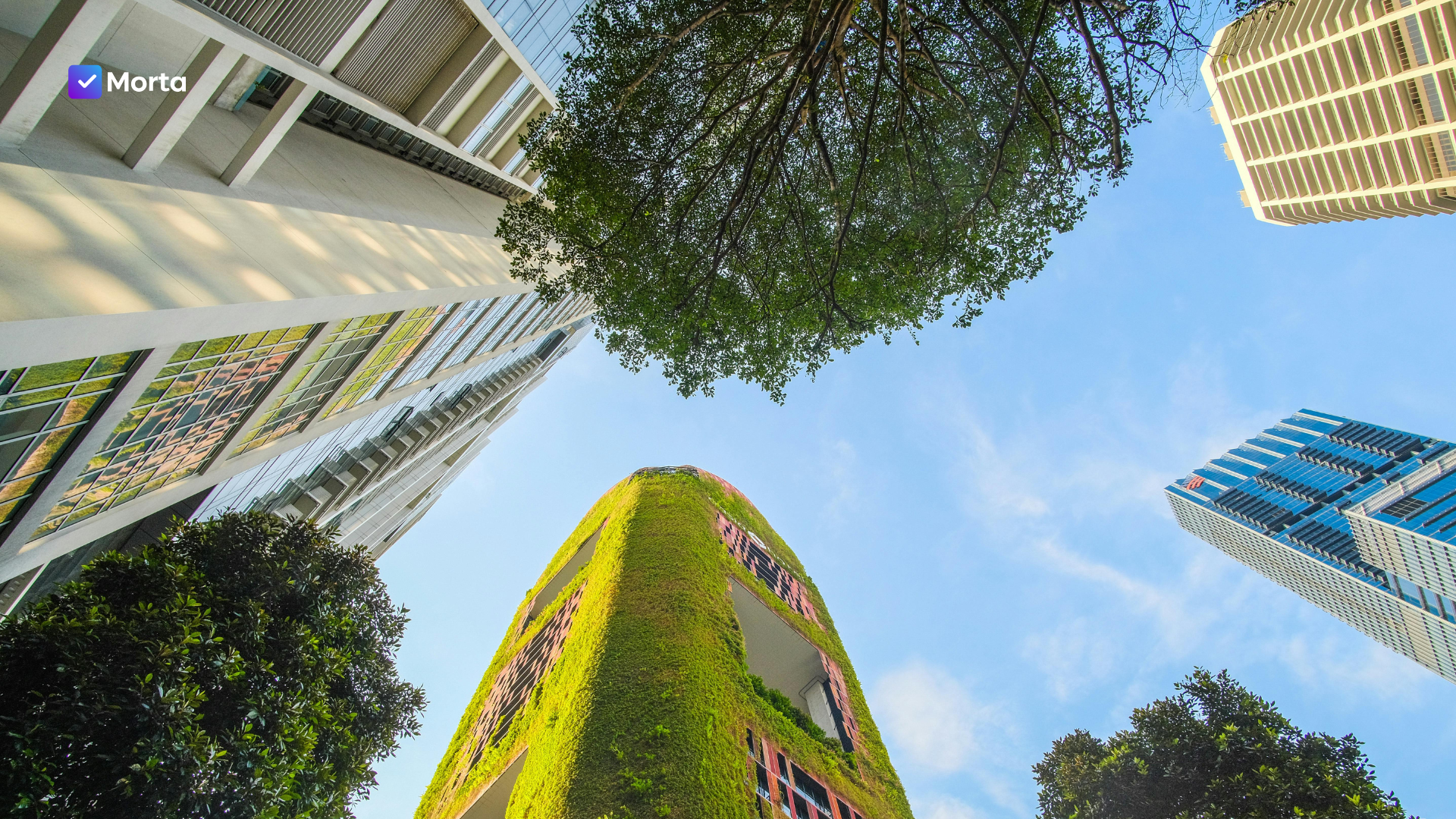
Construction remains one of the world's largest contributors to greenhouse gas emissions.
According to the United Nations Environment Programme, buildings and construction account for approximately 37% of global energy and process-related CO₂ emissions.
That statistic is significant not only for its environmental implications but also for its commercial relevance, as increasingly stringent regulatory frameworks across Europe, heightened energy performance standards, evolving net zero commitments, more informed buyers, and the growing emphasis placed by institutional investors and commercial occupiers on ESG performance and operational efficiency collectively demonstrate that sustainability has become intrinsically linked to investment decision-making.
Developers who ignore this shift may find themselves facing:
None of these outcomes improve profitability.
Try Morta for FreeA persistent misconception within many development organisations is that sustainability is primarily a concern of the construction phase.
This perspective overlooks the extent to which environmental and economic outcomes are determined well before physical works commence. In practice, some of the most consequential sustainability decisions are embedded within the early stages of project planning and design.
Key considerations such as site selection, architectural design, material specification, procurement strategy, programme sequencing and budget allocation collectively shape the long-term performance of a development.
Each of these decisions generates downstream effects that influence not only environmental impact but also cost efficiency, programme certainty and operational performance.
For instance, the selection of locally manufactured materials can reduce transportation-related emissions while simultaneously mitigating supply chain risks. Similarly, designing buildings to maximise natural daylight can enhance energy efficiency without necessitating substantial increases in construction expenditure.
The specification of durable materials and finishes can further contribute to sustainability by reducing lifecycle maintenance requirements and associated costs.
These examples illustrate that sustainability is not an isolated intervention applied at the point of construction or completion. Rather, it is an outcome of integrated decision-making processes that occur during the planning phase, where strategic choices establish the foundation for both environmental performance and long-term asset value.
This is one reason developers increasingly rely on property development software that provides visibility across the entire development lifecycle rather than isolated project stages.
Environmental discussions frequently overlook a fundamental reality: property developments must remain financially viable to be considered “truly sustainable”.
A project that fails to generate sufficient returns or becomes economically unfeasible cannot be regarded as sustainable, regardless of its environmental credentials. Developers are therefore required to navigate a complex set of competing pressures, including rising land acquisition costs, fluctuating interest rates, unpredictable construction inflation, labour shortages that disrupt delivery programmes, and persistent pressure on profit margins.
Within this context, the most effective developers recognise that environmental sustainability and financial sustainability are not opposing objectives but mutually reinforcing priorities. Measures such as reducing material waste can directly lower procurement costs, while more strategic sourcing decisions help eliminate unnecessary expenditure.
Similarly, improved scheduling minimises the risk of costly delays, and accurate, timely reporting enables earlier identification of budget overruns. Ultimately, access to reliable information supports more informed decision-making, allowing developers to achieve both stronger financial outcomes and more sustainable project delivery.
This is where integrated property development software becomes valuable because commercial performance and sustainability often rely on exactly the same project data.
Try Morta for FreeOne of the most practical ways developers can improve sustainability in construction is by reducing waste. Construction generates enormous volumes of waste every year.
According to the UK Government's waste statistics, construction remains one of the country's largest waste-producing sectors.
Every unused material has already consumed:
When materials end up in skips, developers lose money before considering disposal charges.
Improving material forecasting, procurement planning and contractor coordination can significantly reduce unnecessary waste without compromising programme delivery.
Many sustainability problems are communication problems. Design revisions are often issued late, contractors may work from outdated drawings, consultants can operate with different versions of information, and procurement teams sometimes order incorrect quantities.
These issues frequently lead to quality problems that require rework, and every mistake increases waste, labour costs and programme delays. Better collaboration across developers, consultants and contractors helps reduce unnecessary duplication, which has become one of the strongest commercial arguments for digital project management within the property development sector. Instead of sustainability being managed through isolated spreadsheets, teams can make informed decisions using live project information.
Procurement decisions shape much of a project's environmental impact.
Developers often focus heavily on selecting contractors but spend less time reviewing the sustainability of materials and suppliers.
Questions worth asking include:
These questions influence both environmental performance and project profitability.
Developers who establish consistent procurement processes often discover improvements in programme certainty alongside sustainability gains.
Technology does not make developments sustainable on its own.
People still make the decisions.
However, better information allows better decisions to happen more consistently.
Modern property development software gives developers greater visibility into:
When these activities are disconnected, sustainability initiatives often become reactive.
When information is centralised, teams can identify issues much earlier.
This is why many developers are moving away from disconnected spreadsheets towards integrated systems like Morta.
Instead of searching across multiple platforms for project information, development teams can work from one reliable source throughout the project lifecycle.
Try Morta for FreeThe conversation around sustainability in construction in the UK has accelerated significantly in recent years. This shift has been driven by several key factors, including the UK Government's continued pursuit of legally binding net zero commitments, the growing importance of ESG performance among financial institutions, evolving building regulations, increasingly selective institutional investors, and occupiers who now expect lower operating costs.
Developers who prepare for these changes today place themselves in a far stronger competitive position tomorrow. Those who delay until sustainability becomes mandatory across every project often face higher implementation costs, more complex compliance requirements and greater disruption to established processes.
As a result, forward-thinking developers are already embedding sustainable thinking into feasibility studies, procurement strategies and project governance. Rather than treating sustainability as a final compliance exercise, they are incorporating it into the decisions that shape a project's commercial and environmental performance from the very beginning.
Every completed development becomes part of a developer's long-term reputation, with successful projects generating referrals, satisfied investors returning, local authorities gaining confidence, and consultants becoming easier to retain.
Buildings with stronger sustainability credentials often create positive stories that extend beyond marketing, while lower running costs benefit residents, improved energy performance benefits occupiers, and reduced maintenance supports investors. Ultimately, the development performs better long after practical completion, and that long-term thinking increasingly separates established developers from short-term operators.
One of the biggest mistakes organisations make is assuming sustainability is difficult to monitor.
It does not have to be.
Developers can establish measurable objectives from the beginning of each project.
Examples include:
When these metrics are monitored consistently throughout delivery, sustainability becomes part of project management rather than a separate initiative.
This is another area where software for property developers provides practical value.
Reliable reporting makes progress visible.
Visible progress encourages accountability.
Accountability improves outcomes.
The most sustainable developments rarely rely on one revolutionary innovation. Instead, they benefit from hundreds of sensible decisions made consistently, such as choosing suppliers carefully, reviewing budgets regularly, preventing unnecessary rework, reducing procurement delays, managing documentation properly, improving communication, and identifying issues early. These habits improve environmental performance while also strengthening commercial performance, which is exactly what developers should aim for.
Sustainability in construction is no longer a conversation reserved for environmental consultants or planning officers.
It has become part of commercial decision making.
Developers who understand this shift are building businesses that are better prepared for changing regulations, evolving investor expectations and increasingly informed buyers.
The strongest projects are rarely the ones with the largest budgets.
They are usually the ones where information flows clearly, decisions are made confidently and risks are identified before they become expensive problems.
That is exactly where technology can make a meaningful difference.
Morta helps property developers manage projects from planning through delivery and beyond, giving teams better visibility across budgets, collaboration, quality, documentation and handover. When every decision is supported by accurate project information, sustainability becomes easier to achieve without adding unnecessary complexity.
If you're looking for practical ways to improve project delivery while supporting more sustainable developments, book a discovery call with Morta today and see how one connected platform can help you make better decisions across every stage of the development lifecycle.
Try Morta for Free