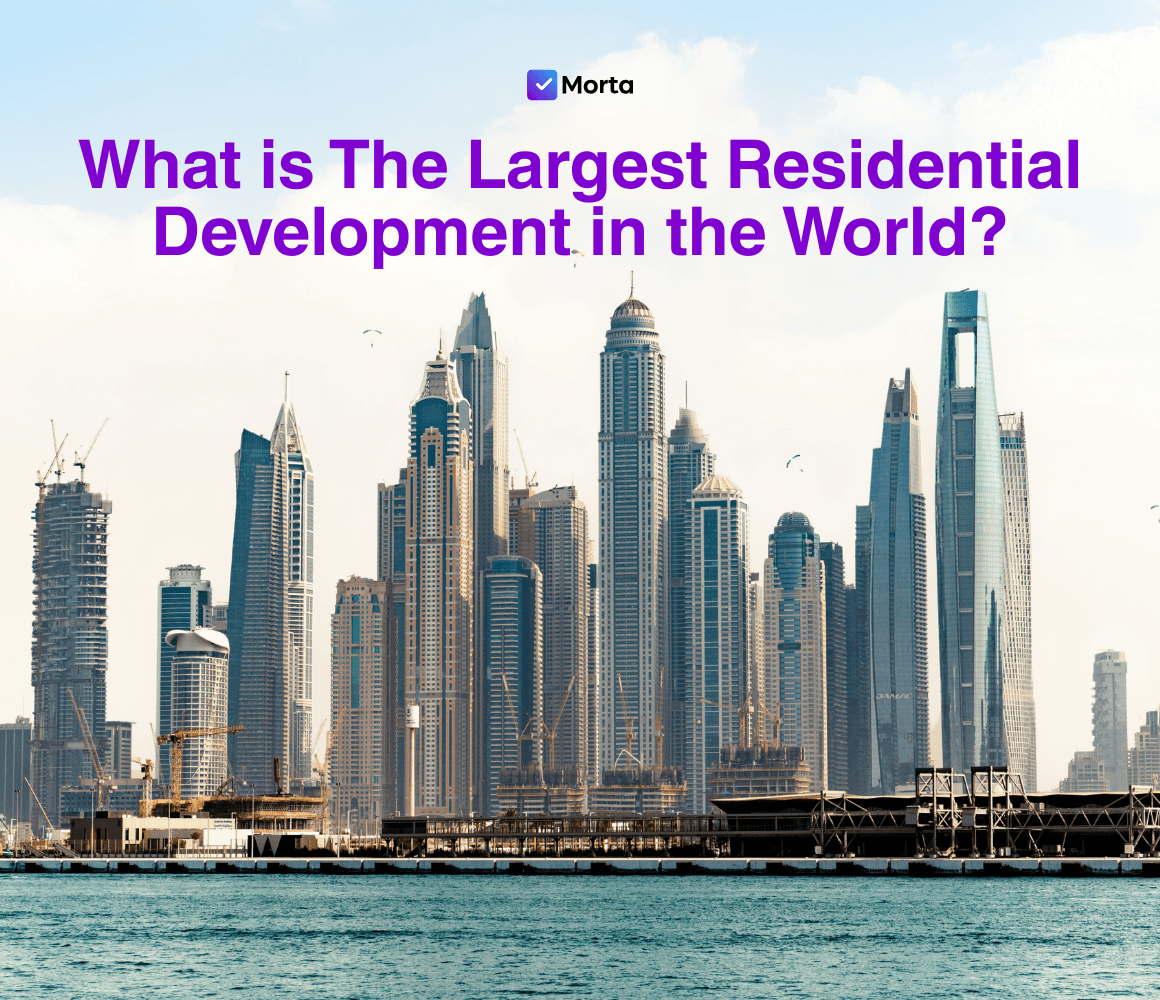
What is The Largest Residential Development in the World? | Morta
Property Development
What is The Largest Residential Development in the World?
Alyssa Castillo
There is a point in every property developer’s career where scale stops being abstract.
You stop thinking in units and start thinking in systems. Infrastructure. Phasing. Capital flow. Long-term control.
That is exactly why studying the largest residential development in the world is interesting and insightful.
Because once you understand how these projects are structured, financed, and delivered, you start to see the difference between building property and building an ecosystem.
And right now, one development stands clearly at the top.
The Largest Residential Development in the World: Dubailand, Dubai
The largest residential development in the world is widely recognised as Dubailand in Dubai. Yes, the city of superlatives and the home of the iconic Burj Khalifa.
Originally announced in 2003, Dubailand is a master-planned development by Dubai Holding, spanning approximately 3 billion square feet. It was designed to house hundreds of thousands of residents across multiple districts, residential communities, and mixed-use zones.
Unlike a single-project residential scheme, Dubailand is not one development in the traditional sense. It is a network of interconnected communities such as Arabian Ranches, The Villa, Mudon, Villanova, Dubai Sports City, and Al Barari.
Each operates independently, yet contributes to a wider master plan.
Why Dubailand Matters to Property Developers
When developers search for the largest residential developments globally, they are often looking for scale benchmarks.
But scale alone does not teach you anything useful.
What Dubailand shows is how large-scale residential development is actually delivered in the real world.
It was never built in one go. It moved in phases, paused when needed, and adapted when market conditions shifted. Parts of the development slowed during the 2008 financial crisis, while others were reintroduced later with different positioning.
From a developer’s perspective, this is the real takeaway.
The largest residential development is never fixed. It responds.
The Shift From Projects to Platforms
Most developers approach residential development as a sequence of projects.
Land is acquired, feasibility is run, units are built, and then sold or held.
Dubailand operates differently. It behaves more like a platform.
Land is released in stages. Developers build within a broader ecosystem. Infrastructure sits above individual projects, while communities are delivered within it.
This creates continuity.
Instead of starting from zero each time, every new phase benefits from existing demand, infrastructure, and positioning.
This is why many of the largest residential real estate developers are moving towards master-planned developments. Control over the wider environment allows for more strategic growth.
What Developers Miss When They Look at Scale
It is easy to focus on numbers. Three billion square feet. Multiple districts. Decades of development.
But the real challenge is operational.
As scale increases, so does complexity. You are no longer managing a single build. You are managing multiple phases, multiple contractors, and shifting timelines, all at once.
Consistency becomes harder to maintain. Costs become harder to track. Decisions carry more weight because they affect not just one project, but several.
This is where many developers feel the strain when moving into larger residential development.
The Role of Timing in Large Residential Development
One of the most underrated aspects of Dubailand is timing.
Not just the launch, but how it adjusted over time.
When market conditions changed, the development did not push forward blindly. It adapted. Certain phases slowed. Others were reworked. Some were introduced later when demand aligned.
That level of flexibility requires clear visibility across the entire development.
Without it, decisions become reactive rather than intentional.
And in large-scale residential development, reactive decisions are expensive.
Where Property Flipping Fits Into This Conversation
At first glance, property flipping feels like a different world entirely.
Short-term, fast-paced, focused on immediate returns.
But the underlying thinking is not that far off.
Property flipping teaches awareness of timing, pricing, and market behaviour. Large-scale residential development applies those same principles across longer timelines.
Instead of flipping a unit, you reposition a phase. Instead of exiting in months, you release supply strategically over years.
The scale changes, but the thinking stays relevant.
The Invisible Layer: Data and Decision-Making
What separates successful large residential developments from those that struggle is not just capital or location.
It is decision-making.
And decision-making at this level relies on clear, reliable data.
Developers need to understand where they stand at any given moment. Not just financially, but operationally. Which phases are performing, where costs are drifting, and what needs attention next.
Without that clarity, projects become harder to control.
This is where the conversation around property development software has become more serious. It is no longer about organisation. It is about maintaining control as complexity increases.
Where Property Development AI Starts to Change the Game
As developments grow, even small inefficiencies start to compound.
A delay in reporting here. A missed update there. A lack of alignment between teams.
Individually, they seem manageable. Together, they slow everything down.
Property development AI is beginning to address this, not in theory, but in practical use cases.
Faster appraisals, clearer comparisons between scenarios, and more accurate reporting all contribute to better decisions being made earlier.
For developers managing multiple residential developments within a larger framework, this speed becomes a real advantage.
The Role of Software for Property Development in Large-Scale Projects
If a development like Dubailand were launched today, the expectations around visibility and control would be significantly higher.
Developers are moving away from fragmented workflows towards systems that bring everything into one place.
This is where platforms like Morta naturally fit into the process.
When feasibility, cost planning, project delivery, and reporting are connected, it becomes easier to understand what is actually happening across your portfolio.
You are no longer chasing information. You have it.
That shift changes how decisions are made.
Instead of reacting to problems, developers can address them early, before they escalate.
A Property Developer’s Lens on Control and Scale
There is a point where scale becomes difficult to manage.
Not because the opportunity is not there, but because visibility starts to break down.
Control in large residential development is not about being involved in every detail. It is about having clarity over the details that matter.
Knowing where your projects stand. Knowing where your risks are. Knowing what decisions need to be made.
Developers who maintain that clarity can scale with confidence.
Those who lose it tend to slow down.
What Dubailand Really Represents
It is easy to label Dubailand as the largest residential development in the world and leave it at that.
But what it really represents is a shift in how property development is approached.
It shows what happens when projects are treated as part of a wider system rather than isolated opportunities.
It shows the value of long-term thinking, structured delivery, and the ability to adapt over time.
For developers looking to grow, that shift is where the real opportunity sits.
Final Thoughts
The largest residential developments globally are not defined by size alone.
They are defined by how well they are managed over time.
Dubailand stands out not just because of its scale, but because of how it has evolved. It has adapted, expanded, and repositioned itself in response to changing conditions.
And that is the real lesson.
Because in property development today, success is not just about what you build.