Why Defect Management Fails on Most Developments (and How to Fix It) | Morta
Property Development
Why Defect Management Fails on Most Developments (and How to Fix It)
Alyssa Castillo
Defects are one of the least glamorous parts of property development, yet they are one of the most expensive.
Whether you are working on your first small property flipping project or managing multiple live developments, defect management has a habit of becoming reactive, rushed, and fragmented. Most developers know defects will appear.
Fewer understand why defect management fails so often, even on well planned schemes.
Before looking at how to fix it, it is worth being clear on what defect management actually is and why it plays such a critical role in successful property development.
What is defect management in property development?
Defect management is the structured process of identifying, recording, tracking, resolving, and signing off defects throughout a development. These defects can range from minor finish issues to serious construction faults that affect safety, compliance, or long term asset value.
In practice, defect management should begin long before handover and continue well into the post completion phase. It is not just about snag lists. It includes how issues are logged, who is responsible for fixing them, how progress is tracked, and how accountability is enforced.
According to the UK Green Building Council, poor quality control and unresolved defects contribute significantly to rework costs and project delays across the construction sector.
Despite this, defect management is often treated as an afterthought, especially on fast moving developments where teams are under pressure to complete and move on.
Why defect management matters more than most developers think
Defects have a compounding effect on property development projects. A missed issue during construction can turn into a delayed completion. A delayed completion can affect sales, financing timelines, and investor confidence. For developers involved in property flipping, unresolved defects can quickly erode margins and damage reputation.
Research published by the Chartered Institute of Building highlights that rework caused by defects can account for up to five percent of total construction costs.
That figure often rises on smaller developments where processes are informal and documentation is inconsistent.
So if defect management is so important, why does it fail so frequently?
The real reasons defect management fails on most developments
Defect management rarely fails because people do not care. It fails because systems, workflows, and ownership are unclear. Below are the most common reasons developers run into trouble.
1. Defects are managed too late
One of the biggest mistakes in property development is treating defect management as a post handover task. By the time keys are being handed over, teams are exhausted, contractors are moving on, and leverage is reduced.
Defects that could have been resolved easily during construction become harder and more expensive to fix once trades have demobilised. Communication slows, documentation goes missing, and responsibility becomes blurred.
Effective defect management starts during the build, not after it.
2. Information is scattered across too many tools
Many developers still manage defects using a combination of spreadsheets, emails, site photos on personal phones, and WhatsApp messages. On small projects this might feel manageable. On larger or multiple developments, it becomes a liability.
When defect information lives in different places, issues are duplicated, forgotten, or disputed. There is no single source of truth. Contractors argue over what was reported and when. Developers waste time chasing updates instead of making decisions.
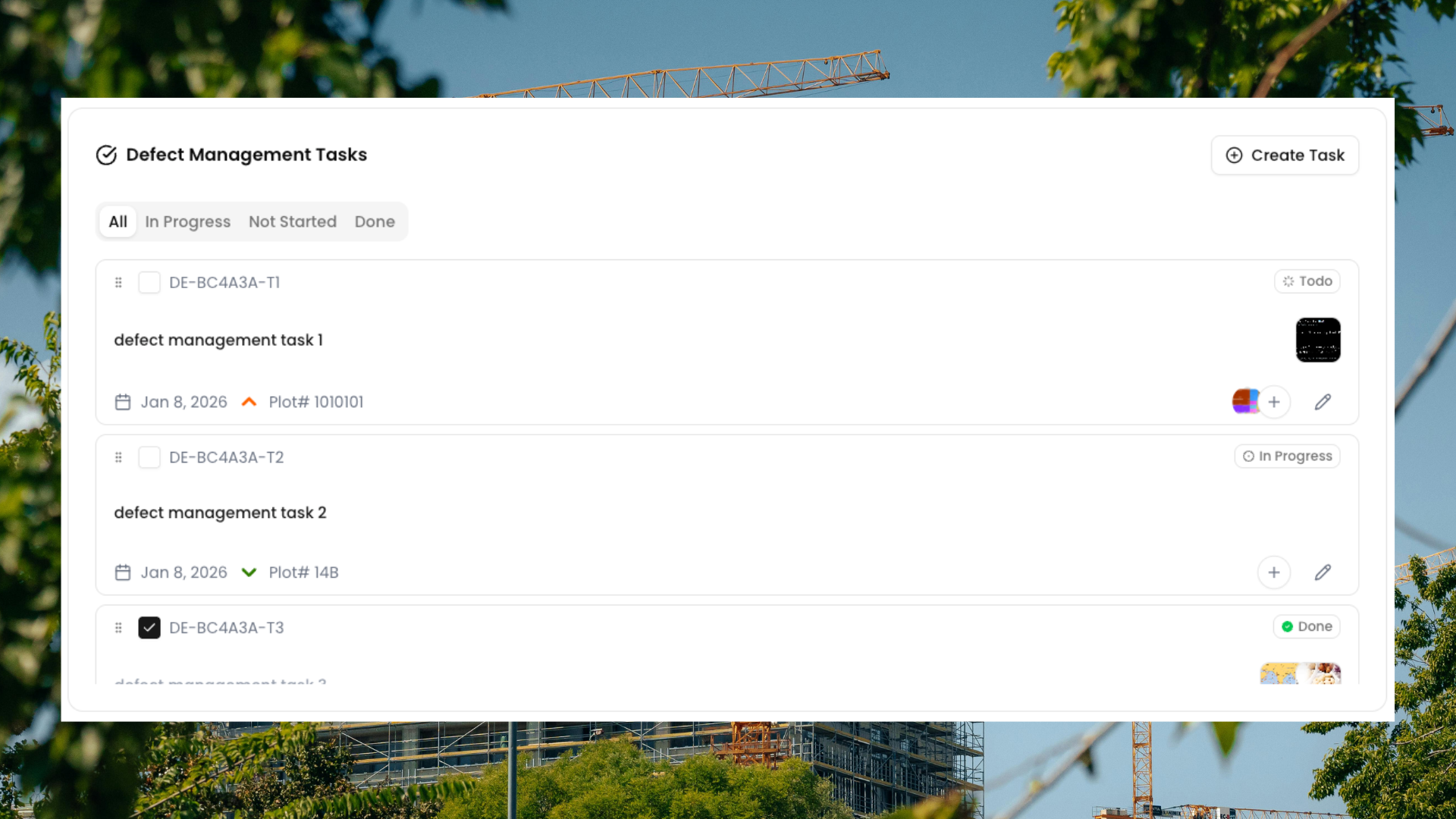
This is where dedicated defect management software or defect management tools begin to matter, especially as projects scale.
3. No clear ownership or accountability
A defect that belongs to everyone often belongs to no one. One of the most common reasons defect management fails is the absence of clear responsibility.
Who logged the defect?
Who is assigned to fix it?
Who signs it off?
What happens if it is not resolved on time?
Without clear ownership, defects drift. Developers end up acting as middlemen, relaying messages between consultants, contractors, and subcontractors.
Strong defect management systems make ownership visible and enforce accountability without constant manual follow up.
4. Poor documentation and audit trails
Disputes over defects are rarely about whether an issue exists. They are usually about timing, scope, or responsibility. Without proper documentation, developers are exposed.
Photos without context, emails without timestamps, and verbal agreements leave too much room for interpretation. This becomes especially risky during final accounts, retention releases, or legal disputes.
Defect management fails when site teams, consultants, and office teams operate in silos. A defect identified on site may never reach the person responsible for approving remedial works. A resolved issue may never be formally signed off.
This lack of alignment creates frustration on all sides. Developers feel out of control. Contractors feel micromanaged. Consultants feel disconnected from day to day realities.
Collaboration is not about more meetings. It is about shared visibility and structured workflows.
Why traditional approaches no longer work
Property development has become more complex. Regulations are tighter. Buyers are more informed. Margins are under pressure. Yet many developers are still relying on manual defect management processes designed for simpler times.
Spreadsheets were never built to manage live construction issues. Messaging apps were never designed to provide audit trails. Email chains break down as soon as team members change.
As developments scale, developers need systems that reflect how modern projects actually operate.
This is where construction defect management software and purpose built platforms start to replace improvised solutions.
How to fix defect management without overcomplicating it
Fixing defect management does not require reinventing your entire operation. It requires tightening a few core principles and supporting them with the right tools.
1. Treat defect management as a continuous process
Defect management should run alongside construction, not trail behind it. Issues should be logged as they appear, assigned immediately, and tracked until resolution.
This approach reduces last minute scrambles and prevents small issues from becoming major delays.
2. Centralise defect data in one system
Whether you are managing one project or ten, all defect information should live in one place. This includes photos, comments, status updates, and sign off records.
Using dedicated defect management tools or software for property developers helps eliminate duplication and confusion. It also creates a clear audit trail that protects developers commercially.
3. Make responsibility visible
Every defect should have a clear owner and a clear status. When responsibility is transparent, accountability improves naturally.
This does not mean blaming teams. It means setting expectations and enabling faster resolution.
4. Integrate defect management with the wider development workflow
Defect management should not exist in isolation. It should connect with project planning, contractor collaboration, and post handover processes.
Developers who use integrated platforms rather than disconnected tools gain better visibility across the entire property development lifecycle.
This is where platforms like Morta property development software quietly change how teams operate. By housing project planning, collaboration, and defect management within the same environment, developers reduce friction without adding complexity.
5. Use data to improve future projects
Defects are not just problems to fix. They are data points. Patterns in defects often reveal deeper issues with suppliers, specifications, or construction sequencing.
When defect data is structured and searchable, developers can use it to improve future developments, reduce risk, and protect margins.
Defect management and property flipping
For developers involved in property flipping, defect management can be the difference between a profitable exit and a stressful one.
Fast timelines and tight budgets leave little room for rework. Clear defect tracking helps ensure issues are resolved before sale or refinance, not discovered during surveys or buyer inspections.
Learning proper defect management is a key part of learning property development itself, especially for newer developers moving from single refurbishments to more complex schemes.
Where software fits into modern defect management
Not every developer needs enterprise level systems. But most developers outgrow spreadsheets faster than they expect.
Defect management software and construction defect management software exist to support structured workflows, not to add bureaucracy. The best software for property developers removes manual admin, improves visibility, and supports better decisions.
Morta software approaches this from a developer perspective rather than a contractor one. Defect management sits alongside planning, cost control, collaboration, and post handover processes, which reflects how developers actually work.
For teams already using Morta CRM or other Morta construction tools, defect management becomes part of a wider system rather than another standalone app to maintain.
Final thoughts
Defect management fails on most developments because it is treated as a task instead of a system. Late starts, scattered information, unclear ownership, and weak documentation all contribute to unnecessary cost and stress.
Developers who invest time in setting up proper defect management processes, supported by the right software for property developers, protect their projects, their reputation, and their long term growth.
Whether you are learning property development or managing multiple live schemes, getting defect management right is one of the quiet advantages that separates reactive developers from resilient ones.
And the developers who scale successfully tend to solve these problems earlier than they think they need to.